

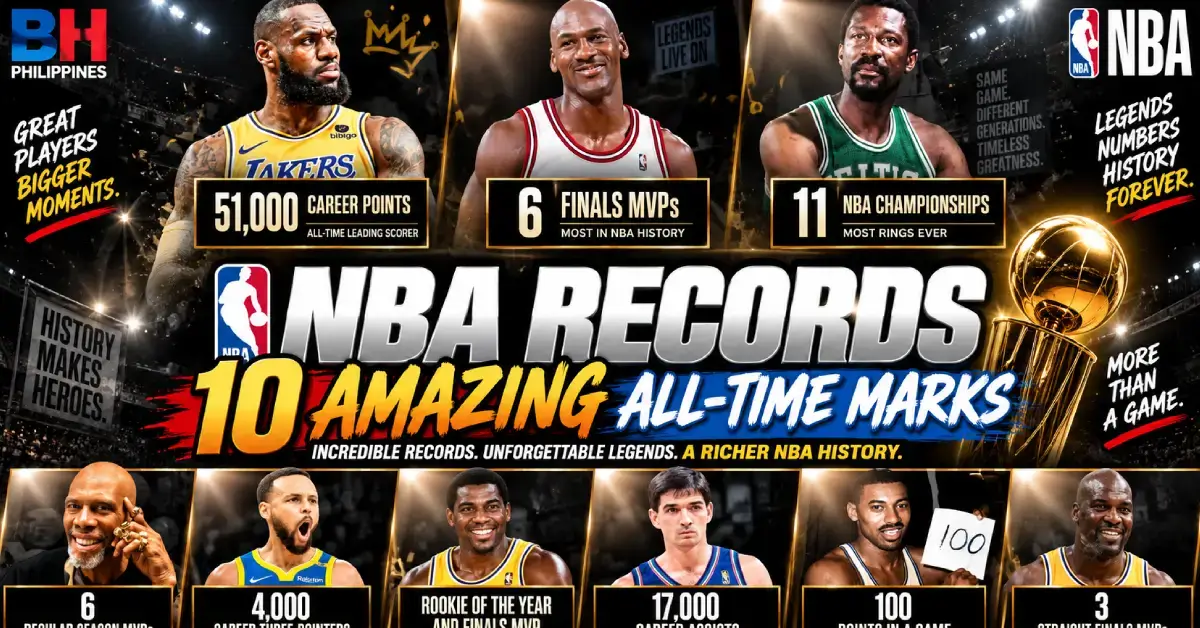
NBA records are some of the best ways to understand how basketball has evolved. From Wilt Chamberlain’s legendary 100-point game to John Stockton’s incredible assist total and Bill Russell’s 11 championships, the NBA record book is filled with achievements that continue to define basketball history.
Table of Contents
The most important records are not always the biggest numbers. Some show incredible scoring ability, while others demonstrate playmaking, defense, rebounding, longevity, or winning. The NBA’s official record resources separate regular-season leaders, playoff leaders, single-game records, team records, and other historical achievements, making it easier to understand the different ways players and teams have made history.
For basketball fans in the Philippines, knowing these records adds another layer to following the NBA. Whether you’re watching today’s superstars or debating the greatest players of previous generations, historical statistics provide context for those conversations.
This guide explores some of the most significant NBA all time records, explains why they matter, and looks at which achievements could remain difficult to break.
What are the most important NBA all time records?
The NBA record book contains hundreds of statistical achievements, but several records have become particularly important because of their historical significance.
The following NBA records list focuses on individual and team achievements that have helped define different eras of professional basketball.
Who holds the NBA single-game scoring record?
Wilt Chamberlain — 100 points
Wilt Chamberlain’s 100-point performance remains one of the most famous records in professional sports.
On March 2, 1962, Chamberlain scored 100 points for the Philadelphia Warriors against the New York Knicks in a 169-147 victory. He played all 48 minutes, shot 36-for-63 from the field and made 28 of 32 free throws. He also collected 25 rebounds. The NBA confirmed in its updated historical coverage that the 100-point performance remains the league’s single-game scoring record.
What makes the achievement so remarkable is not simply the number 100.
Scoring 100 points requires extraordinary offensive volume and efficiency. A player has to remain on the floor, receive enough possessions, make difficult shots, draw fouls, and maintain scoring production throughout the game.
Modern NBA offenses regularly produce high-scoring games, but Chamberlain’s record has survived for more than six decades.
That makes it one of the clearest examples of an NBA record that has become part of basketball folklore.
Chamberlain also appears repeatedly throughout the record book. NBA.com credits him with several extraordinary marks, including 55 rebounds in a game, 118 career games with at least 50 points, and a 50.4-point scoring average during the 1961-62 season.
Who has the NBA career scoring record?
LeBron James
The NBA’s career scoring record is another achievement that demonstrates the importance of longevity.
LeBron James became the league’s all-time regular-season scoring leader in 2023 after passing Kareem Abdul-Jabbar.
Unlike Chamberlain’s single-game record, LeBron’s scoring achievement was built over an extremely long career. It required elite production combined with the ability to remain productive through many NBA seasons.
This distinction is important when looking at NBA all time records.
A single-game record can come from one extraordinary night. A career record requires thousands of possessions and years of sustained performance.
LeBron’s statistical profile is also unusual because he has contributed heavily in several categories. His career includes major totals in points, assists, rebounds, games played, playoff appearances, and other statistical categories.
That combination makes his record particularly difficult to reproduce.
Who has the NBA’s all-time assists record?
John Stockton — 15,806 assists
John Stockton remains the standard for career assists in NBA history.
The former Utah Jazz point guard finished his career with 15,806 assists. He also finished with 3,265 steals, another historic NBA record.
Stockton’s assist record demonstrates why statistics such as assists require more context than simply looking at a number.
An assist begins with the passer, but another player has to finish the possession. Stockton therefore needed not only exceptional court vision but also reliable teammates and an offensive system that allowed him to consistently create scoring opportunities.
His partnership with Karl Malone became one of the most recognizable pick-and-roll combinations in NBA history.
Stockton’s career is also an example of consistency. Reaching 15,806 assists cannot be accomplished through one or two spectacular seasons. It requires thousands of successful possessions over many years.
For that reason, Stockton’s assist record deserves a prominent place on any serious NBA records list.
Who holds the NBA all-time steals record?
John Stockton — 3,265 steals
Stockton’s defensive record is just as impressive as his passing achievement.
He finished his NBA career with 3,265 steals, giving him another place at the top of the league’s historical record book.
Steals are often associated with quick hands, but elite defensive anticipation is equally important.
A guard has to read passing lanes, understand offensive actions, pressure ball handlers, and recognize when an aggressive defensive play is worth the risk.
Stockton consistently created defensive opportunities without relying solely on physical size.
His combination of career assists and steals illustrates an important point about the most NBA records: statistical greatness can come from many different basketball skills.
Scoring is only one way to dominate.
Who has the NBA career rebounding record?
Wilt Chamberlain — 23,924 rebounds
Wilt Chamberlain also owns the NBA’s career rebounding record with 23,924 rebounds. NBA.com notes that he led the league in rebounding in 11 of his 14 seasons.
That number reflects one of the defining characteristics of Chamberlain’s career: dominance around the basket.
Rebounding requires positioning, timing, strength, anticipation, and the ability to establish space against other big men.
Chamberlain combined those skills with unusual athletic ability.
His career rebounding total is particularly impressive because it was accumulated during an era when traditional centers played enormous roles around the basket.
His 55-rebound single-game performance is another example of just how dominant he could be on the glass.
When discussing NBA records, Chamberlain’s name appears so frequently because his career combined scoring, rebounding, efficiency, and individual statistical production at an extraordinary level.
Who has won the most NBA championships as a player?
Bill Russell — 11 championships
Bill Russell holds one of the most important winning records in basketball history.
Russell won 11 NBA championships in 13 seasons with the Boston Celtics. NBA.com identifies him as an 11-time champion and a five-time NBA MVP.
This record is different from points, rebounds, or assists because championships are team accomplishments.
One player cannot win an NBA championship without teammates, coaches, and an effective organization.
However, Russell’s defensive impact and leadership were central to Boston’s dynasty.
His career demonstrates that the NBA record book is not limited to individual statistics. Championships, awards, games played, and other accomplishments are also important parts of basketball history.
Russell’s 11 titles remain the benchmark for players who want to measure individual championship success.
The modern NBA has a different competitive structure, making it extremely difficult for one player to reproduce that level of sustained team success.
Which NBA records could be the hardest to break?
Some records appear more vulnerable than others.
A record becomes particularly difficult to break when it requires a rare combination of circumstances.
Chamberlain’s 100 points is a perfect example.
Today’s NBA has outstanding scorers, higher three-point volume, and offensive systems designed to create efficient scoring opportunities. Yet reaching 100 points still requires an extraordinary workload.
Stockton’s 15,806 assists is difficult for another reason.
A modern point guard would need to maintain an elite assist rate for an exceptionally long career. The player would also need to stay healthy, remain a primary ball handler, and play for teams that generate plenty of made baskets.
Russell’s 11 championships presents an entirely different challenge.
Free agency, salary-cap rules, greater competitive balance, and the increasing depth of NBA talent make it difficult for one player to remain on championship-caliber teams for an entire decade.
That is why the most NBA records cannot simply be ranked by the size of the number.
The circumstances behind the number matter.
Which NBA records show how basketball has changed?
The NBA’s evolution has changed the statistics that players can accumulate.
Three-point shooting is perhaps the clearest example.
Earlier generations relied much more heavily on post scoring, mid-range jumpers, and interior offense. Modern offenses use spacing, pick-and-rolls, drive-and-kick actions, transition opportunities, and high-volume three-point shooting.
As offensive strategy changes, certain records become easier to approach while others become harder.
The same applies to assists.
A team that generates more made three-pointers can create additional assist opportunities for its primary playmakers. Modern offensive systems can also give one player a greater share of the ball-handling responsibility.
This is why historical records should always be viewed within their era.
A record from the 1960s does not exist under the same statistical environment as a record from the 2020s.
That does not make older achievements less impressive.
It makes historical context more important.
Why should fans separate regular-season and playoff records?
Regular-season and playoff records measure different forms of performance.
The regular season is a long marathon. Players have to perform across many games, road trips, back-to-back schedules, injuries, lineup changes, and different opponents.
The playoffs are different.
The number of teams decreases, opponents become more familiar, defensive game plans become more specific, and every possession carries greater consequences.
The NBA’s official historical records resource separates regular-season and playoff leaders for categories including points, rebounds, assists, steals, blocks, field goals, three-pointers, and minutes.
This distinction is important when comparing players.
A player can be a regular-season statistical leader without holding a major playoff record.
Another player might have a relatively modest regular-season statistical profile but become one of the most productive performers in postseason history.
Neither accomplishment should automatically be considered more valuable.
They answer different questions.
How should fans compare NBA records from different eras?
Comparing eras is one of the most interesting parts of NBA history, but it should be done carefully.
The rules have changed.
The pace has changed.
The three-point line has changed.
Training and conditioning have changed.
Offensive schemes have changed.
The number of teams has changed.
Even the way players are used has evolved.
A modern center may be asked to defend on the perimeter and shoot three-pointers. Earlier centers generally spent much more time around the basket.
Similarly, today’s guards can operate with enormous amounts of space because of three-point shooting.
These differences affect statistics.
The best approach is not to dismiss historical numbers but to understand them within their context.
Chamberlain’s 100-point game should be appreciated as a remarkable performance from his era. Stockton’s assists should be understood through his role and longevity. Russell’s championships should be considered alongside the Celtics’ team structure and his enormous defensive influence.
That makes discussions about NBA records more interesting than simply asking which number is the biggest.
What is the best way to keep an NBA records article updated?
An NBA history article should be built so that individual sections can be updated without rewriting the entire page.
That is particularly important for active players.
A career scoring total can change after every game. Games played can change after every appearance. Three-pointers, rebounds, assists, and other totals can also change throughout a season.
A strong NBA records list should therefore identify the record holder, the current record value, and the date on which the statistic was verified.
For historical records held by retired players, updates may be less frequent.
For active players, however, editors should periodically verify the figures against official NBA statistics.
The NBA’s own historical records page directs readers toward its statistics section for more detailed individual and team records.
This creates a simple editorial workflow: explain the record, cite the authoritative source, add the relevant date, and revisit the page when an active player approaches the milestone.
Why are NBA records important to Filipino basketball fans?
Basketball is deeply connected to sports culture in the Philippines, and NBA history remains an important part of that conversation.
Fans often debate the greatest scorer, point guard, center, defender, champion, or overall player.
Records help make those conversations more meaningful.
For example, a discussion about point guards becomes more interesting when Stockton’s assist and steals records are part of the conversation.
A debate about scoring can include both Chamberlain’s 100-point game and LeBron’s career scoring achievement.
A conversation about winning can include Russell’s 11 championships.
The numbers do not settle every basketball argument.
Instead, they give fans another way to understand the careers behind the arguments.
That is the real value of the NBA all time records.
They connect today’s NBA to the players and teams that shaped the league before the modern era.
Conclusion: What do NBA records tell us about basketball history?
NBA records tell the story of basketball through numbers. Wilt Chamberlain’s 100-point game represents extraordinary single-game scoring, while his 23,924 career rebounds demonstrate dominance over an entire career. John Stockton’s 15,806 assists and 3,265 steals show how consistency and decision-making can create records that survive for generations. Bill Russell’s 11 championships demonstrate the value of team success and defensive leadership.
Meanwhile, modern stars such as LeBron James show how longevity can reshape the NBA record book. The most important lesson is that no single statistic completely defines greatness. Some NBA all time records reward scoring, others reward playmaking, defense, rebounding, durability, or winning.
As the NBA continues to evolve, some historic marks will eventually fall, while others may remain untouched for decades. That continuing competition is what makes the NBA records so fascinating for basketball fans. The record book is not simply a list of numbers—it is a timeline of how the game has changed.
Join the Discussion
Which NBA records do you think will stand the longest? Is Wilt Chamberlain’s 100-point game the ultimate untouchable record, or do you believe a modern superstar could eventually challenge it? Share your opinion and join the conversation with fellow basketball fans. If you’re looking for basketball-inspired merchandise in the Philippines, visit the Basketball Hub PH T-Shirt collection for basketball T-shirts or explore the Basketball Hub PH Wall Art collection for basketball-themed artwork.
You can also browse the store for jerseys and other general merchandise. For more basketball content, NBA history, NBA records, updates, and new merchandise, follow Basketball Hub PH on Facebook and Basketball Hub PH on Instagram.
Frequently Asked Questions
What is the most famous NBA record?
Wilt Chamberlain’s 100-point game is arguably the most famous individual NBA record. He scored 100 points for the Philadelphia Warriors against the New York Knicks on March 2, 1962. The mark remains the league’s single-game scoring record.
Who has the most assists in NBA history?
John Stockton holds the NBA career assists record with 15,806 assists. He also holds the league’s career steals record with 3,265.
Who has won the most NBA championships?
Bill Russell holds the record for most NBA championships won by a player, with 11 titles during his career with the Boston Celtics.
Who has the most rebounds in NBA history?
Wilt Chamberlain holds the NBA career rebounding record with 23,924 rebounds. He also led the NBA in rebounding 11 times.
Where can I check current NBA records?
The official NBA historical records page is a useful starting point because it separates regular-season, playoff, game, and other records and directs readers to the NBA statistics database for more detailed information.