
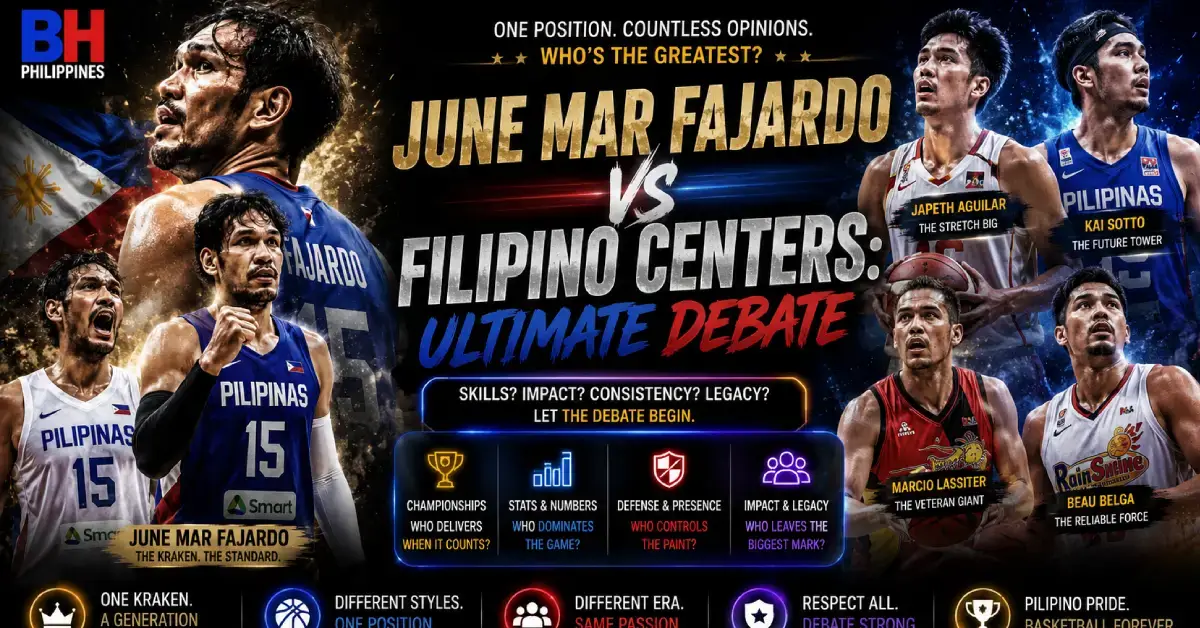
When discussing June Mar Fajardo vs Filipino centers, the strongest case for Fajardo comes from the combination of dominance, longevity, championships, individual awards, and national-team service.
He is not automatically the greatest simply because he is the most accomplished modern center. Filipino basketball has produced exceptional big men across several generations, including Asi Taulava, Japeth Aguilar, Benjie Paras, Ramon Fernandez, Abet Guidaben, and others.
Table of Contents
However, Fajardo has built an unusually strong résumé.
FIBA lists Fajardo at 211 centimeters, or 6-foot-11, and identifies him as a center for the Philippines. His senior international career included appearances across multiple FIBA competitions and three World Cups.
At the PBA level, his case becomes even stronger.
Fajardo won eight PBA MVP awards through 2024 and remained a major force for the San Miguel Beermen well into the latter part of his career.
So when Filipino basketball fans ask who is the greatest center, the real question is not simply who was the biggest or most athletic.
It is:
Who combined the most dominance, consistency, team success, and impact?
That is where the Fajardo debate becomes fascinating.
How Should We Compare Filipino Basketball Centers?
Comparing different generations of Filipino basketball centers requires more than looking at career points or rebounds.
Basketball has changed dramatically.
The PBA of the 1980s was not the same league as the PBA of the 2010s or 2020s. International basketball has also evolved, with modern offenses emphasizing spacing, pick-and-roll coverage, three-point shooting, and defensive versatility.
The best comparison should therefore consider several factors.
1. Peak dominance
How difficult was the player to defend during his best years?
2. Longevity
How long did the player remain an elite contributor?
3. Championships
How often did the player help his team win?
4. Individual awards
MVP awards, Mythical Team selections, Finals MVP honors, and other recognition provide evidence of sustained excellence.
5. International impact
A player’s contribution to the Philippine national team matters when discussing the greatest Gilas centers.
6. Skill set
Scoring, rebounding, passing, defense, athleticism, mobility, and basketball IQ all matter.
Using those categories produces a more balanced comparison.
Why Is June Mar Fajardo the Benchmark?
Fajardo’s biggest advantage in this discussion is sustained dominance.
He was not simply an excellent center for a short period.
He became the centerpiece of San Miguel’s championship era and one of the defining players of his generation.
His eight PBA MVP awards through 2024 are particularly significant. The Philippine News Agency reported his eighth MVP after he topped the statistical race and voting process.
Fajardo’s impact was also visible in the postseason.
He developed a reputation as a powerful low-post scorer who could establish deep position, finish over defenders, rebound in traffic, and create opportunities for teammates when defenses collapsed.
His size made him difficult to move.
His touch around the basket made him difficult to leave open.
His understanding of positioning allowed him to remain effective even as the league became faster.
That combination is the foundation of his case as one of the best Filipino centers ever.
How Does June Mar Fajardo Compare With Asi Taulava?
The June Mar Fajardo vs Asi Taulava debate is one of the most interesting center comparisons in Philippine basketball.
Taulava, known as “The Rock,” was one of the dominant big men of his generation.
He brought enormous physical strength, rebounding, interior scoring, and toughness.
Fajardo arrived later and played in a different basketball environment.
That makes direct statistical comparisons difficult.
Taulava’s longevity was remarkable.
He remained a relevant PBA center for many years and became one of the league’s recognizable big men.
Fajardo, however, produced a higher level of sustained individual dominance.
The biggest difference is the MVP résumé.
Fajardo’s eight MVP awards give him a major advantage when measuring regular-season dominance.
Taulava’s career should not be reduced to awards, though.
He was an important national-team player and a major PBA presence during the 2000s and beyond.
He represented a physical style of center play that was extremely difficult for opponents to handle.
June Mar Fajardo vs Asi Taulava: Who Had the Better Prime?
If the question is purely about peak PBA dominance, the advantage goes to Fajardo.
His MVP run established a level of individual consistency that few PBA players have matched.
Fajardo became the first player to win three consecutive PBA MVP awards, and he eventually added more MVP trophies to his résumé. GMA News reported on his third straight MVP in 2016, highlighting the historical significance of the achievement.
Taulava’s prime was also impressive, particularly because of his physical presence and durability.
But Fajardo combined dominance with a broader collection of team and individual accomplishments.
That gives him the edge.
Verdict: Fajardo.
Still, Taulava remains one of the most important names whenever the conversation turns to the greatest Filipino big men.
How Does June Mar Fajardo Compare With Japeth Aguilar?
The June Mar Fajardo vs Japeth Aguilar comparison is different because Aguilar has generally operated more as a power forward than a traditional center.
FIBA lists Aguilar at 206 centimeters, or 6-foot-9, and identifies him as a power forward.
That distinction matters.
Aguilar’s greatest strengths have often been his athleticism, length, transition ability, shot-blocking, and finishing above the rim.
Fajardo’s game has traditionally been more centered around physicality, post positioning, rebounding, and half-court offense.
If a team needs a traditional interior anchor, Fajardo is the obvious choice.
If a team wants a mobile frontcourt player who can run, defend different positions, and attack the rim, Aguilar provides a different advantage.
That is why this comparison should not be viewed simply as “who is taller?”
They solve different basketball problems.
June Mar Fajardo vs Japeth Aguilar: Which Skill Set Wins?
For a traditional center role, Fajardo wins.
His post game and interior strength make him better suited to controlling possessions around the basket.
For a modern, athletic frontcourt role, Aguilar has a compelling case.
His ability to run the floor and finish above the rim gives him an element that Fajardo does not emphasize in the same way.
Aguilar has also been an important long-term Gilas player.
FIBA records national-team appearances for Aguilar dating back to 2009, including multiple FIBA Asia competitions and World Cups.
Therefore, the comparison depends heavily on the question.
Best traditional center: Fajardo.
Most athletic versatile big: Aguilar.
Overall PBA dominance: Fajardo.
Gilas longevity and versatility: Aguilar has a strong argument.
Who Are the Best Filipino Centers in PBA History?
There is no universally accepted ranking, but several names consistently belong in the conversation.
June Mar Fajardo
Fajardo has the strongest modern résumé.
His MVP awards, championships, longevity, and national-team career make him the benchmark for his generation.
Asi Taulava
Taulava represents power and durability.
He was one of the defining Filipino big men of the 2000s and remained productive for an unusually long career.
Benjie Paras
Paras occupies a special place in PBA history.
He remains the only player to win both Rookie of the Year and MVP in the same season, making his early career one of the most remarkable individual starts in league history.
Ramon Fernandez
Fernandez is another essential name.
His passing ability, basketball IQ, rebounding, scoring, and overall skill made him much more than a traditional center.
Abet Guidaben
Guidaben was another dominant interior presence from an earlier generation and a multiple-time PBA MVP.
These players demonstrate why calling Fajardo the greatest is not a simple decision.
Philippine basketball has produced several generations of exceptional big men.
Who Are the Greatest Gilas Centers?
The answer changes when the discussion moves specifically to the national team.
International basketball rewards different skills.
A center must defend pick-and-rolls, protect the rim, rebound against bigger opponents, and survive physical matchups against international frontcourts.
Fajardo’s Gilas career was extensive.
He debuted internationally in 2013 and played in the 2014, 2019, and 2023 FIBA World Cups. His FIBA profile records a senior international career average of 6.3 points and 4.1 rebounds per game across the listed competitions.
He also played at the 2025 FIBA Asia Cup, where he averaged five points and three rebounds across five games.
His international numbers were not as dominant as his PBA résumé.
That is an important distinction.
Fajardo was a major Filipino center internationally, but he was not producing the same statistical dominance against the world’s strongest teams that he produced in the PBA.
That does not weaken his legacy.
It simply provides context.
How Does Fajardo’s International Career Affect the Debate?
It strengthens his overall case but does not automatically make him the greatest international Filipino center.
His national-team career lasted 13 years.
He appeared in three World Cups.
He was part of the Philippines’ Asian Games gold-medal team.
He also helped represent multiple generations of Gilas Pilipinas.
That longevity matters.
International basketball is demanding, and national-team careers can change quickly because of injuries, roster changes, and younger players emerging.
Fajardo remained part of the conversation for more than a decade.
That makes his national-team contribution significant.
At the same time, his FIBA statistics show that his greatest dominance was achieved in the PBA rather than on the global stage.
That is why the most accurate description is not that Fajardo was unquestionably the greatest international Filipino center.
It is that he was one of the country’s most accomplished centers across both professional and national-team basketball.
Does PBA Dominance Make Fajardo the Greatest?
For an all-time PBA center ranking, it is one of the strongest arguments available.
Fajardo’s MVP record is extraordinary.
His consistency was equally impressive.
He remained a dominant presence even as opponents changed defensive schemes to limit him.
Teams knew they could not allow him to establish comfortable position near the basket.
That created opportunities for San Miguel’s perimeter players.
Fajardo’s presence therefore affected the entire offensive structure.
When a defense sent additional help inside, shooters could find open looks.
When opponents stayed home on shooters, Fajardo could attack single coverage.
That is the value of an elite interior hub.
His success also came within a highly successful San Miguel era.
The combination of individual awards and team accomplishments makes his PBA résumé particularly difficult to challenge.
Which Filipino Center Had the Most Complete Game?
This question may produce a different answer.
Fajardo is arguably the most dominant traditional center.
But Ramon Fernandez provides an interesting counterargument because of his passing and all-around skill.
Aguilar brings athleticism and versatility.
Taulava brings physicality and durability.
Paras brings a unique combination of size, athleticism, and early-career dominance.
Each player represents a different interpretation of the center position.
That is why “greatest” and “most complete” should not always mean the same thing.
A player’s ranking depends on the criteria.
If the priority is post scoring and sustained dominance, Fajardo has an enormous advantage.
If the priority is passing and all-around basketball IQ, Fernandez becomes a stronger candidate.
If athletic versatility is the priority, Aguilar becomes more attractive.
What Makes Fajardo Different From Earlier Filipino Centers?
The modern game requires centers to operate differently.
Traditional low-post scoring remains valuable, but teams increasingly expect big men to participate in pick-and-rolls, make quick reads, defend in space, and support perimeter-oriented offenses.
Fajardo adapted without abandoning his biggest strengths.
His post game remained his foundation, but he also became a better passer and decision-maker.
That adaptability helped extend his career.
It also allowed him to remain valuable even when the PBA became more perimeter-oriented.
This is one reason his legacy deserves more than a simple comparison of physical statistics.
He succeeded in a changing basketball environment.
What Does Fajardo’s National-Team Retirement Mean for His Legacy?
Fajardo’s international retirement in 2026 gives fans a natural point to evaluate his entire Gilas career.
His final game came against Iran at the Mall of Asia Arena.
The Philippines won 68-56, and Fajardo scored six points and grabbed two rebounds in just over seven minutes.
FIBA reported that he finished with 70 senior FIBA appearances.
That final appearance was symbolic because it closed a 13-year national-team journey.
His retirement also creates a new challenge for Philippine basketball.
The next generation of centers must now carry the responsibility that Fajardo held for years.
Players such as Kai Sotto and AJ Edu offer different skill sets and physical profiles.
The future will not necessarily look like the Fajardo era.
That is part of basketball’s natural evolution.
So, Who Is the Greatest Filipino Center?
If the question is who had the strongest overall combination of PBA dominance, longevity, individual awards, championships, and national-team service, June Mar Fajardo has the strongest modern-era argument.
That does not erase the accomplishments of Taulava, Aguilar, Paras, Fernandez, Guidaben, and other great big men.
It simply recognizes that Fajardo’s résumé is unusually complete.
The June Mar Fajardo vs Filipino centers debate therefore has a reasonable conclusion.
Best traditional PBA center case: June Mar Fajardo
His sustained dominance and MVP résumé give him the edge.
Best physical presence: Asi Taulava
Taulava’s strength and durability made him one of the most recognizable Filipino big men of his era.
Best athletic versatility: Japeth Aguilar
Aguilar’s mobility, length, and ability to play above the rim distinguish him from traditional centers.
Most complete historical challenge: Ramon Fernandez
Fernandez’s all-around skill set makes him one of the strongest arguments from an earlier generation.
Most unique early-career résumé: Benjie Paras
His Rookie-MVP achievement remains one of the most extraordinary accomplishments in PBA history.
The final ranking can still be debated.
But Fajardo belongs at or near the top.
Final Verdict: Where Does Fajardo Rank?
The simplest answer is that June Mar Fajardo belongs in the conversation for the greatest Filipino center ever.
His strongest advantage is not one spectacular statistic.
It is the total package.
He combined elite PBA dominance with championship success, MVP recognition, long-term consistency, and a 13-year Gilas career.
FIBA’s records confirm his three World Cup appearances and extensive senior national-team résumé.
The comparison with Asi Taulava highlights Fajardo’s superior award résumé.
The comparison with Japeth Aguilar highlights the difference between traditional interior dominance and athletic versatility.
The comparison with Fernandez and Paras shows how difficult it is to compare different generations.
Ultimately, there may never be a universally accepted answer.
Basketball greatness is partly statistical and partly contextual.
But if Filipino fans are asked to build a list of the best Filipino centers, Fajardo’s name should be near the top.
And if the discussion is specifically about the greatest Gilas centers of the modern era, his 13 years of service make his case even stronger.
Conclusion
June Mar Fajardo vs Filipino centers is more than a comparison of statistics, awards, and championships. It is a look at different generations of Philippine basketball and the players who helped define the center position. From Asi Taulava’s physical dominance to Japeth Aguilar’s athletic versatility, Filipino basketball has produced remarkable big men. However, Fajardo’s combination of PBA success, individual awards, longevity, and Gilas Pilipinas experience gives him one of the strongest cases for being considered among the greatest Filipino centers of all time. His legacy will continue to influence how future generations of Filipino basketball fans evaluate greatness, dominance, and excellence on the court.
Join the Discussion
Be part of the conversation surrounding June Mar Fajardo vs Filipino centers! Follow BasketballHubPH on our social media channels for the latest Philippine basketball news, updates, and insights about your favorite players and teams. Don’t forget to visit our online store for basketball-inspired T-shirts, jerseys, wall art, and other general merchandise for Filipino basketball fans. Join the conversation and connect with fellow fans who share your passion for Philippine basketball and the incredible legacy of its greatest centers!
Frequently Asked Questions
Is June Mar Fajardo the greatest Filipino center ever?
There is no official all-time ranking, but Fajardo has one of the strongest cases. His PBA dominance, MVP awards, championships, longevity, and national-team career put him firmly in the greatest-center conversation.
Who was better, June Mar Fajardo or Asi Taulava?
For sustained PBA dominance, Fajardo has the stronger case. Taulava was an outstanding physical center with remarkable longevity, but Fajardo’s MVP résumé gives him a significant advantage.
Who was more athletic, June Mar Fajardo or Japeth Aguilar?
Aguilar has the stronger athleticism argument. FIBA lists Aguilar at 6-foot-9 and as a power forward, while Fajardo is listed at 6-foot-11 and plays center. Their skill sets are therefore quite different.
Was June Mar Fajardo a dominant Gilas Pilipinas player?
Fajardo was an important long-term Gilas player, appearing in three FIBA World Cups and accumulating 70 senior FIBA appearances. His international role was generally different from his much more dominant PBA role.
Who could become the next great Filipino center after Fajardo?
Kai Sotto and AJ Edu are two of the most obvious names for the next generation. They offer different strengths, with Sotto providing exceptional size and Edu bringing mobility and defensive versatility.