
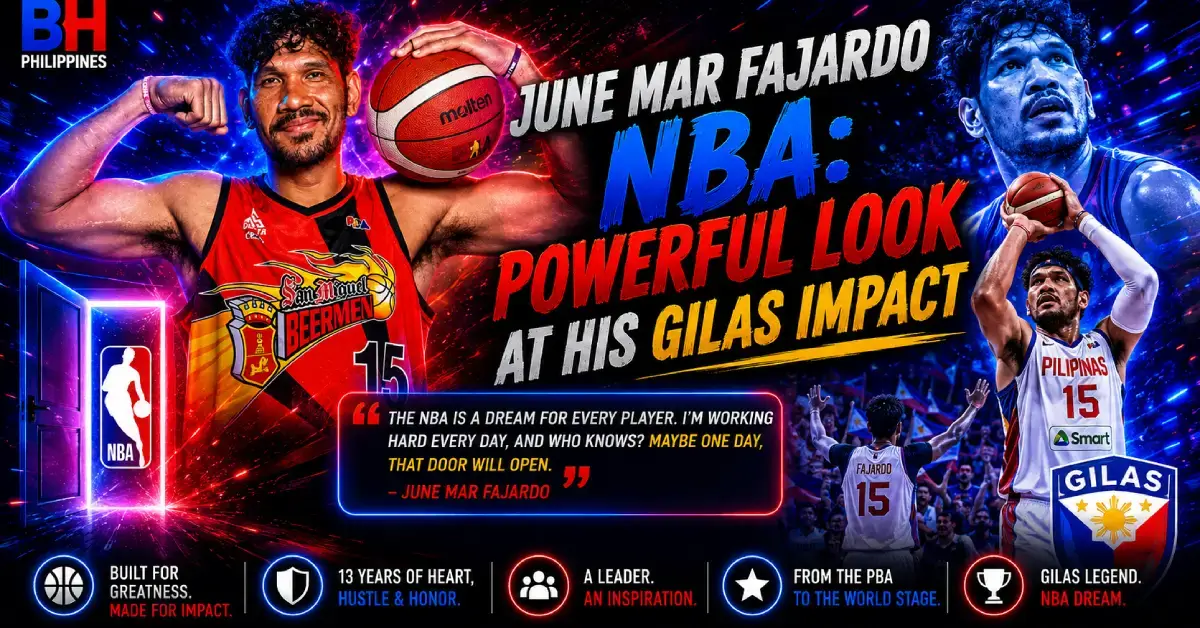
The June Mar Fajardo NBA discussion needs one important clarification: June Mar Fajardo never played in an NBA regular-season game. His professional career was built in the Philippines with the San Miguel Beermen, while his international career centered on Gilas Pilipinas and FIBA competition. That does not make the NBA question irrelevant. In fact, examining how Fajardo’s skills might have translated to the world’s most demanding basketball league helps explain both his strengths and the unique value he brought to Philippine basketball.
At 6-foot-11, with elite PBA production, exceptional rebounding, soft hands, post scoring, physical strength, and years of international experience, Fajardo possessed many qualities associated with professional basketball centers. But the NBA is a different environment. Pace, spacing, athleticism, defensive versatility, and three-point shooting place different demands on big men.
Table of Contents
The more interesting question, therefore, is not simply whether Fajardo could have played in the NBA. It is how his particular skill set would have needed to adapt—and what his actual career tells us about his impact on Gilas Pilipinas.
Did June Mar Fajardo Ever Play in the NBA?
No. June Mar Fajardo did not play in an NBA regular-season game.
His professional career began in the PBA after the Petron Blaze Boosters selected him first overall in the 2012 PBA Draft. He subsequently became the centerpiece of the San Miguel Beermen and one of the most decorated players in Philippine basketball.
Internationally, Fajardo represented the Philippines for more than a decade. FIBA’s official profile lists him as a 211-centimeter, or 6-foot-11, center and records his senior national-team appearances across numerous FIBA competitions.
That distinction matters because online searches for “June Mar Fajardo NBA” can sometimes blur the line between NBA potential, NBA comparisons, and an actual NBA career.
There is no NBA playing résumé to evaluate.
Instead, there is a fascinating hypothetical: how might a player with Fajardo’s physical profile and skill set have translated to the NBA?
Why Does the June Mar Fajardo NBA Question Matter?
For Filipino basketball fans, the question represents something bigger than one player.
The Philippines has produced many talented basketball players, but Fajardo’s combination of size and domestic dominance made him one of the country’s most intriguing prospects of his generation.
At 6-foot-11, he possessed a physical profile that is valuable at virtually every level of basketball.
He could establish position in the low post, rebound through contact, finish around the rim, set strong screens, and use his body to create space.
His PBA résumé demonstrated that these skills could be extremely effective against professional competition.
The NBA question therefore provides a useful way to analyze his game.
Which parts of his skill set were transferable?
Which areas would have required development?
And why did his role change when he moved from PBA basketball to international competition?
Those questions provide a better understanding of Fajardo than simply asking whether he was “good enough” for the NBA.
What Made June Mar Fajardo Special as a Basketball Player?
Fajardo’s biggest advantage was his combination of size, strength, touch, and basketball intelligence.
Standing 6-foot-11, he was naturally difficult to defend.
But height alone does not produce an elite center.
Fajardo developed the ability to seal defenders, receive entry passes, finish with either hand around the basket, and use controlled footwork in the post.
He also became a powerful rebounder.
Offensive rebounding was particularly valuable because it gave his team additional possessions while forcing opposing defenders to box him out.
Defensively, his size allowed him to occupy space near the basket and contest shots without needing to gamble.
Another important skill was screening.
A good screen can create separation for a guard without the screener ever taking a shot. Fajardo became highly effective at setting physical screens, rolling toward the basket, and presenting himself as a target.
This skill became especially useful with Gilas Pilipinas, where his role was often less about being the primary scorer and more about creating advantages for the entire offense.
How Did His PBA Game Translate to International Basketball?
This is where the June Mar Fajardo NBA discussion becomes particularly interesting.
Fajardo was one of the most dominant players in the PBA, but his international statistics were considerably more modest.
FIBA’s official career records currently list his senior international average at 6.3 points, 4.1 rebounds, and 0.7 assists per game. His record includes appearances at the 2014, 2019, and 2023 FIBA Basketball World Cups.
That difference does not mean his international game was unsuccessful.
It demonstrates the difference between basketball environments.
In the PBA, Fajardo could receive a greater percentage of offensive possessions and operate as a primary interior scorer.
Internationally, he faced larger frontcourts, faster guards, aggressive help defense, and opponents capable of targeting slower-footed big men in pick-and-roll situations.
As a result, his responsibilities changed.
He became more valuable as a screener, rebounder, interior defender, post option, and physical presence.
That adaptation is an important part of his career.
What Was the Fajardo Gilas Role?
The Fajardo Gilas role evolved over time.
When he first joined the senior national team in 2013, Fajardo was still developing.
The 2013 FIBA Asia Championship was his introduction to major senior international competition. The Philippines won silver and qualified for the 2014 World Cup, creating one of the defining moments of the modern Gilas Pilipinas program.
Fajardo’s role was limited at that stage.
As his PBA career developed, however, his experience and confidence increased.
He became a more established option in the national-team frontcourt.
His role could change from game to game.
Against a large traditional center, his physicality and post game could become important.
Against a faster opponent, the coaching staff could reduce his minutes and emphasize more mobile lineups.
That willingness to accept different assignments helped him remain useful to Gilas across multiple generations.
What Was June Mar Fajardo’s National Team Impact?
The June Mar Fajardo national team impact was about reliability as much as production.
For more than a decade, Gilas Pilipinas had a proven Filipino center who understood the physical demands of international basketball.
Fajardo represented the country through different coaching eras and with different generations of teammates.
He appeared in three FIBA World Cups and accumulated 70 senior-level FIBA appearances across his international career. FIBA reported that his final national-team appearance came in August 2026, ending a 13-year Gilas career.
That longevity matters.
International basketball requires players to repeatedly adjust to new opponents, new systems, new teammates, and unfamiliar environments.
Fajardo did that for years.
He also provided an important connection between the Gilas team of 2013 and the younger players who emerged later.
When younger big men joined the national program, they were not simply entering a roster.
They were joining a frontcourt that had been shaped in part by Fajardo’s example.
What Was His Biggest Contribution to Gilas?
Fajardo’s most obvious contribution was his interior presence.
But his biggest contribution may have been his ability to make different lineups work.
A center affects the game even without touching the ball.
When Fajardo set a screen, he could open a driving lane.
When he established post position, defenders had to decide whether to send help.
When he boxed out, a teammate could secure the rebound.
When he occupied the paint, opposing players had to consider his size before attacking the rim.
These small advantages can influence an entire possession.
His offensive responsibilities also changed depending on the talent around him.
Gilas has featured elite guards, wings, naturalized players, and other frontcourt talents over the years.
Fajardo did not always need to be the first offensive option.
Instead, he could contribute through complementary skills.
That is a major reason his June Mar Fajardo contribution to Gilas should not be judged solely by points per game.
Why Was His International Role Different From His PBA Role?
This is perhaps the most important tactical point in analyzing Fajardo.
The PBA and FIBA basketball are not identical.
In the PBA, Fajardo became accustomed to being an offensive focal point.
He could establish himself on the block, demand a double team, and punish smaller defenders.
FIBA basketball can make those possessions more difficult.
International teams often have multiple strong defenders who can provide help from the weak side.
Guards are also more likely to pressure the ball aggressively.
Spacing has become increasingly important.
That creates a dilemma for traditional centers.
If the center stays near the paint, he can protect the rim and rebound.
But if the opposing team puts him into repeated pick-and-roll actions, the defense may have to protect larger spaces.
This was one of the challenges identified in international analysis of Fajardo’s later career. ESPN noted that opponents could target his defense in pick-and-roll situations while also acknowledging that his post game remained a valuable offensive option.
The important point is that Fajardo was not simply “good in the PBA and bad internationally.”
His role was different because the tactical environment was different.
Could June Mar Fajardo Have Fit an NBA System?
Hypothetically, Fajardo’s best NBA fit would likely have depended heavily on the system surrounding him.
His traditional center skills were legitimate.
A team looking for a physical backup center, rebounder, screen setter, and interior scorer could theoretically find value in those qualities.
However, NBA basketball places enormous demands on defensive mobility.
Centers increasingly have to defend pick-and-rolls, survive switches, protect the rim, rebound, and sometimes guard space well beyond the restricted area.
Modern NBA offenses also place significant value on shooting.
A center who can stretch the floor creates additional spacing for guards.
Fajardo’s established game was primarily built around interior scoring rather than three-point shooting.
That would have created a major question about offensive fit.
The NBA is also more athletic and longer than most domestic professional leagues.
A player’s success depends not simply on height but on how quickly he can process and respond to the speed of the game.
Therefore, any claim that Fajardo definitely would have succeeded in the NBA would be speculative.
The evidence supports something more measured: he possessed legitimate professional center qualities, but his NBA translation cannot be proven because he never played there.
What Would Have Been His Biggest NBA Strengths?
If we imagine Fajardo entering an NBA system during his prime, several strengths would immediately stand out.
First, size.
At 6-foot-11, he would have had the physical dimensions of an NBA center.
Second, strength.
Fajardo built his reputation around physical play and his ability to establish position.
Third, rebounding.
His willingness to battle for position would have been useful against larger frontcourts.
Fourth, screening.
Teams constantly need centers who can create separation for ball-handlers.
Fifth, interior finishing.
Fajardo’s soft hands and post scoring could have created opportunities around the basket.
Sixth, experience.
By the time he became an established PBA star, he had accumulated years of professional basketball and international competition.
Those traits would have given him a foundation.
But a foundation is not the same thing as an NBA career.
What Would Have Been His Biggest NBA Challenges?
The challenges would have been equally important.
The first would be defensive mobility.
NBA teams can repeatedly attack a center through high pick-and-rolls.
A slower-footed big can be forced to make difficult choices between protecting the rim and covering the ball-handler.
The second would be spacing.
Modern NBA offenses frequently ask centers to operate in systems where every player must create or preserve driving lanes.
Without a consistent outside shot, Fajardo would have needed to create value through screening, rolling, offensive rebounding, and interior finishing.
The third would be athleticism.
NBA centers encounter elite athletes every night.
Even traditional post players have to defend against explosive guards and mobile forwards.
The fourth would be adapting to a deeper three-point line and a larger floor.
Those factors would increase the amount of space a center must defend.
These are not criticisms of Fajardo.
They are simply the realities that any traditional center would face when moving into NBA basketball.
What Does Gilas Without June Mar Fajardo Look Like?
The question of Gilas without June Mar Fajardo is now much more relevant because his international career officially ended in 2026.
His final Gilas game came against Iran in the FIBA World Cup 2027 Asian Qualifiers.
The Philippines won 68-56, while Fajardo contributed six points and two rebounds in seven minutes and five seconds. FIBA described his brief appearance as a major momentum-changing moment in the second quarter.
His departure creates a clear frontcourt transition.
Gilas now has to distribute the responsibilities previously handled by a veteran who understood the physical requirements of international basketball.
Younger centers such as Kai Sotto and AJ Edu bring different skill sets.
Sotto provides size and a developing perimeter-oriented game.
Edu offers mobility, athleticism, and defensive versatility.
Those differences could eventually allow Gilas to play a faster style.
But replacing Fajardo is not about finding another player who looks exactly like him.
It is about replacing the functions he performed.
Rebounding.
Screening.
Interior scoring.
Physical defense.
Veteran experience.
Communication.
The next Gilas frontcourt will need to combine those responsibilities across multiple players.
What Does His Retirement Mean for Philippine Basketball?
Fajardo’s retirement from Gilas represents a generational transition.
For 13 years, Filipino fans watched him move from an inexperienced national-team big man to one of the program’s most recognizable veterans.
FIBA reported that Fajardo’s international career ended after 70 senior FIBA games and three FIBA World Cup campaigns.
His retirement therefore closes more than one player’s chapter.
It closes a connection to the early modern Gilas era.
Fajardo was there when the Philippines returned to the World Cup.
He was there during subsequent qualification campaigns.
He played in the 2019 and 2023 World Cups.
He was part of the Philippine team that won men’s basketball gold at the Asian Games.
And he remained with the program long enough to see younger players begin taking larger roles.
That is why his retirement matters historically.
What Is the Lasting June Mar Fajardo Impact?
The June Mar Fajardo impact cannot be reduced to his PBA statistics or FIBA averages.
His greatest influence may be the standard he established for Filipino big men.
For years, Fajardo showed that a local center could dominate the PBA through fundamentals, strength, positioning, patience, and consistency.
He also demonstrated that a player could have an important international career without reproducing his domestic statistics.
That distinction is valuable.
The best national-team players are not always the players who score the most.
They are players who understand what the team needs.
Fajardo’s willingness to screen, rebound, defend, pass, post up, and accept changing minutes made him useful even when his offensive role became smaller.
That adaptability is a major part of his June Mar Fajardo national team impact.
His example also gives younger players a blueprint.
International basketball is not simply about individual talent.
It is about fitting talent into a system.
What Can Young Filipino Big Men Learn From Fajardo?
There are several lessons.
The first is that fundamentals remain valuable.
Footwork, positioning, rebounding, screening, passing, and finishing do not become obsolete.
The second is that strength matters, but it must be paired with skill.
Fajardo did not become a great center simply because he was tall.
He learned how to use his body.
The third is adaptability.
A player may be the first offensive option for his club and a complementary piece for the national team.
That is not a demotion.
It is part of team basketball.
The fourth is longevity.
Fajardo’s career demonstrates the value of remaining committed to development and preparation.
Finally, young players can learn that international basketball requires honesty about weaknesses.
If opponents target a certain action, the solution is not to ignore it.
It is to improve the skill, change the coverage, or adjust the role.
That mentality can help the next generation of Gilas players.
What Is the Real Lesson Behind June Mar Fajardo NBA?
The real lesson is that NBA comparisons should not determine a player’s value.
Fajardo did not need an NBA career to become one of the most important Filipino basketball players of his generation.
His PBA achievements speak for themselves.
His Gilas career adds another layer.
His international résumé includes three World Cups, an Asian Games gold medal, and 70 senior FIBA appearances.
That is a significant basketball legacy.
The NBA represents one possible destination for elite basketball players.
But it is not the only measurement of greatness.
Fajardo became dominant in the PBA, competed successfully on the international stage, and helped shape the identity of Gilas Pilipinas for more than a decade.
His career shows that a player can build a meaningful legacy without ever stepping onto an NBA court.
Conclusion
The June Mar Fajardo NBA question is ultimately less about whether he played in the NBA and more about understanding the qualities that made him one of the most important Filipino centers of his generation. Fajardo never appeared in an NBA regular-season game, but his 6-foot-11 frame, interior scoring, rebounding, screening, physicality, and basketball intelligence made him a dominant PBA player and a valuable member of Gilas Pilipinas.
His greatest contribution came through adaptability. He learned to move from being a primary offensive option in the PBA to a more specialized role in international basketball. He competed in three FIBA World Cups, accumulated 70 senior FIBA appearances, and remained part of Gilas for 13 years.
Now that his national-team career has ended, Gilas Pilipinas enters a new frontcourt era. Younger players will bring different skills, but Fajardo’s influence will remain. His career showed that greatness does not require an NBA résumé. It can also be built through consistency, championships, international service, resilience, and a willingness to do whatever the team needs.
That is the real June Mar Fajardo impact—not what might have happened in the NBA, but what he actually accomplished for Philippine basketball.
Join the Discussion
Be part of the conversation surrounding June Mar Fajardo NBA! Follow BasketballHubPH on our social media for the latest Philippine basketball news, player updates, Gilas Pilipinas stories, and basketball analysis. Don’t forget to visit our online store for basketball-inspired T-shirts, jerseys, wall art, and other general merchandise for Filipino basketball fans.
Share your thoughts on June Mar Fajardo’s career, his impact on Gilas Pilipinas, and whether you think his skill set could have translated to the NBA. Join the conversation and connect with fellow fans who share your passion for June Mar Fajardo NBA and Philippine basketball!
Frequently Asked Questions
Did June Mar Fajardo ever play in the NBA?
No. June Mar Fajardo never played in an NBA regular-season game. His professional career was primarily built in the PBA, while his international career was with Gilas Pilipinas.
Could June Mar Fajardo have played in the NBA?
It is impossible to know for certain. His 6-foot-11 frame, strength, post game, rebounding, screening, and professional experience provided useful qualities for a center, but NBA-level athleticism, defensive mobility, and spacing requirements would have presented significant challenges.
What was June Mar Fajardo’s role with Gilas Pilipinas?
His role varied depending on the opponent and roster. He provided interior scoring, rebounding, screens, physical defense, and veteran experience while sometimes accepting a smaller offensive role.
What is June Mar Fajardo’s national team impact?
Fajardo gave Gilas Pilipinas more than a decade of continuity and frontcourt experience. He played in three FIBA World Cups and finished with 70 senior FIBA appearances.
What will Gilas Pilipinas look like without June Mar Fajardo?
Gilas will need to distribute his responsibilities among younger big men and potentially use more mobile frontcourt lineups. Kai Sotto, AJ Edu, and other emerging players can provide different strengths rather than attempting to duplicate Fajardo’s exact playing style.