
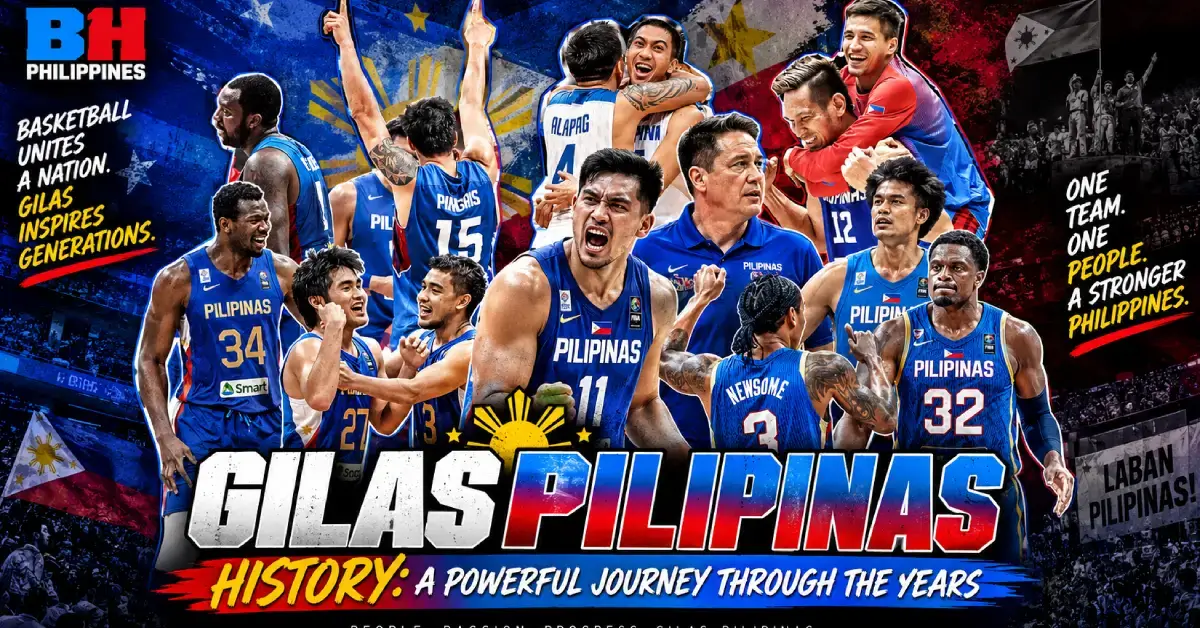
What is the history of Gilas Pilipinas? Gilas Pilipinas is the name associated with the modern Philippine men’s national basketball program, but its story is part of a much longer Philippine basketball tradition. The modern Gilas program was established in 2009, while the Philippine national basketball team had already achieved major international success many decades earlier.
Table of Contents
The history of Gilas is defined by rebuilding, heartbreak, major breakthroughs, and unforgettable performances against Asia’s best teams. From the emotional 2013 FIBA Asia Championship to the 2014 World Cup, the 2023 FIBA Basketball World Cup on home soil, the historic 2023 Asian Games gold medal, and the upset of Latvia in 2024, Gilas has continued to shape the modern identity of Philippine basketball.
For Filipino fans, understanding Gilas Pilipinas history means understanding how the national team evolved from an Asian basketball powerhouse into a program determined to compete consistently on the global stage.
How did the Philippine national basketball team begin?
The story of the Philippine national basketball team started long before the name Gilas Pilipinas became familiar to modern fans.
Basketball arrived in the Philippines around the beginning of the 20th century. The YMCA played an important role in spreading the sport, and basketball quickly became part of Filipino sporting culture. The country later developed strong collegiate basketball traditions, including the NCAA Philippines in 1924 and the UAAP in 1938.
The Philippines became an important force in Asian basketball.
One of the country’s earliest major international achievements came at the inaugural FIBA Asia Cup in 1960. Playing as hosts in Manila, the Philippines won all nine of its games and captured the championship. The country also won the tournament in 1963, 1967, 1973, and 1986.
The Philippines also achieved a historic third-place finish at the 1954 FIBA World Championship, which remains the country’s best-ever finish in the competition.
Those achievements are essential to understanding the history of Gilas. The modern national team did not appear from nowhere. It inherited a basketball culture and international tradition that had already existed for generations.
When did Gilas Pilipinas officially begin?
The modern Gilas Pilipinas program emerged in 2009, with Serbian coach Rajko Toroman serving as its first head coach. Japeth Aguilar was among the early members of the program and later became one of its longest-serving national-team players.
The goal was straightforward: build a stronger, more competitive Philippine national team capable of challenging the best teams in Asia and eventually returning to the FIBA Basketball World Cup.
The project required more than individual talent.
Gilas needed continuity, coaching, player development, and a commitment from the country’s best basketball players. The program also developed a distinctive identity around toughness, ball movement, outside shooting, defensive pressure, and the Filipino concept of puso, or playing with heart.
The early years were not always smooth. International basketball is different from the PBA. National teams have limited preparation time, FIBA rules differ from professional league rules, and opponents such as Iran, China, Korea, and Japan regularly field highly organized squads.
Still, the foundation had been laid.
What made the 2013 Gilas team so important?
The 2013 FIBA Asia Championship was arguably the biggest turning point in modern Gilas Pilipinas history.
The Philippines hosted the tournament in Manila, giving the national team an extraordinary home-court advantage. Thousands of passionate supporters packed the Mall of Asia Arena and created an atmosphere that became part of the tournament’s story.
But the team had to overcome more than pressure.
In the semifinal, Gilas faced Korea, a team that had caused the Philippines years of heartbreak in major Asian competitions. The Philippines eventually won 86–79, ending a long drought against Korea in FIBA Asia competition.
The victory became one of the defining moments in the history of Gilas.
Jayson Castro, Jimmy Alapag, LA Tenorio, Marc Pingris, Ranidel de Ocampo, Gabe Norwood, and their teammates combined speed, shooting, defense, toughness, and composure.
Gilas eventually lost to Iran in the championship game, 85–71, but the silver medal was enough to qualify the Philippines for the 2014 FIBA Basketball World Cup. It was the country’s first World Cup appearance since 1978.
The 2013 team therefore did more than win a medal.
It reopened the door to the global stage.
How did Gilas Pilipinas perform at the 2014 FIBA World Cup?
The 2014 FIBA Basketball World Cup in Spain became one of the most memorable chapters in Gilas Pilipinas history.
The Philippines entered a difficult group featuring Croatia, Greece, Argentina, Puerto Rico, and Senegal. The team was not expected to dominate, but it repeatedly demonstrated that it could compete with elite international opponents.
Gilas came close to several major upsets.
The Philippines pushed Croatia and Argentina and competed strongly against Puerto Rico and Greece. The team eventually earned its breakthrough victory against Senegal.
Gilas defeated Senegal 81–79 in overtime, with Jimmy Alapag and naturalized center Andray Blatche leading the way. It was especially meaningful because it ended a more than 40-year wait for a Philippine victory at the World Championship level.
The result did not send Gilas into the knockout stage, but that was not the main story.
The 2014 team proved that Philippine basketball could compete with stronger and bigger nations.
For Filipino fans, the World Cup became a celebration of competitiveness, resilience, and national pride.
What happened to Gilas Pilipinas after 2014?
After the 2014 World Cup, Gilas entered a period of transition.
The program continued to compete in FIBA Asia competitions and other international tournaments while managing changes in coaching staff and player personnel.
The 2015 FIBA Asia Championship became another important chapter. Gilas reached the championship game for the second consecutive edition, again finishing with a silver medal.
Jayson Castro was one of the team’s key players. At the 2015 tournament, he averaged 16.7 points, 3.2 rebounds, and 2.6 assists per game and earned another All-Star Five selection. FIBA notes that he became the only Filipino player to earn back-to-back All-Star Five selections at the time.
The result demonstrated that the 2013 breakthrough was not a one-time event.
Gilas had established itself as one of Asia’s leading national teams.
Why was 2015 another important year?
The 2015 campaign reinforced the idea that the Philippines could consistently compete deep into major Asian tournaments.
Gilas defeated Lebanon in the quarterfinals and Japan in the semifinals before facing Iran in the championship game. Castro delivered another impressive tournament and became one of the most recognizable guards in Asian basketball.
Although the Philippines again fell short of the gold medal, consecutive silver medals showed that the program had moved into a different category.
The challenge was no longer simply qualifying for major competitions.
The challenge was winning them.
That distinction became increasingly important as a new generation of Filipino players emerged.
What did Gilas achieve in the 2019 World Cup cycle?
The road to the 2019 FIBA Basketball World Cup was complicated by changes in the international qualification system.
Instead of relying only on a single continental tournament, teams competed through a series of FIBA World Cup Qualifiers.
The Philippines remained a major basketball nation in Asia, but the qualification process exposed the difficulty of maintaining consistency against strong regional opponents.
Gilas eventually qualified for the 2019 World Cup in China.
However, the tournament was difficult. The Philippines finished without a win in the group phase and exited early.
The result was disappointing, but it also highlighted a key reality of the history of Gilas: international basketball rewards sustained development, not simply individual star power.
The national program needed to develop players who could compete against bigger frontcourts, faster guards, and increasingly sophisticated international offenses.
How did Gilas Pilipinas prepare for the 2023 World Cup?
The 2023 FIBA Basketball World Cup was particularly important because the Philippines was one of the tournament’s co-hosts.
The country had waited decades to host basketball’s biggest international event again. The tournament gave Filipino fans the chance to watch the world’s best national teams in Manila while also putting enormous attention on Gilas.
The team went through coaching and roster changes during the qualification process. FIBA noted that the Philippines used multiple coaches during the Asian Qualifiers before Chot Reyes guided the team through much of the campaign.
The national team also welcomed one of the biggest names in modern basketball, Jordan Clarkson, who joined Gilas for the World Cup.
Playing at home created enormous expectations.
The Philippines did not advance to the knockout stage, but the tournament still became a major event in Philippine sporting history.
The home crowd demonstrated once again why basketball holds such a powerful place in Filipino culture.
Why was the 2023 Asian Games gold medal historic?
If the 2013 FIBA Asia silver medal represented a breakthrough, the 2023 Asian Games gold medal represented a historic achievement.
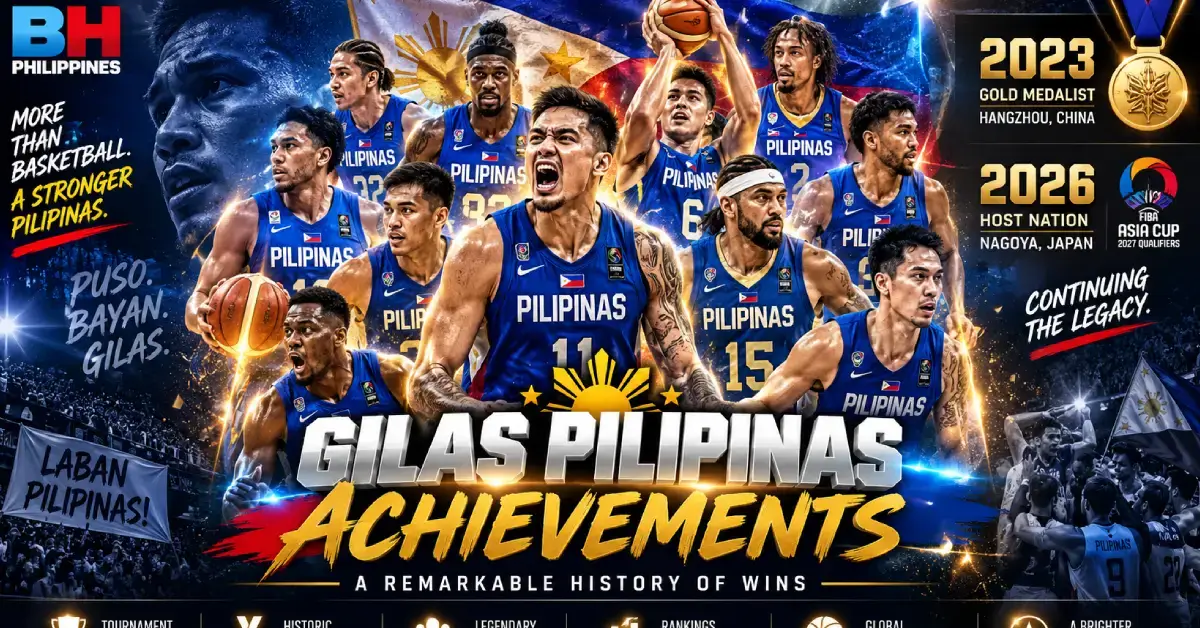
Gilas Pilipinas won the men’s basketball gold medal at the 19th Asian Games in Hangzhou, China.
The achievement ended a 61-year wait for the Philippines to win the men’s basketball title at the Asian Games.
Justin Brownlee became a central figure in the campaign, while players such as Scottie Thompson and Chris Newsome contributed to a team that blended experience, athleticism, defense, and shot-making.
The gold medal was particularly meaningful because it came after decades of frustration.
The Philippines had historically been one of Asia’s strongest basketball nations, but the country had not won the Asian Games men’s basketball title since 1962.
Gilas finally ended that drought.
The victory also gave the modern program a major championship to place alongside its earlier silver-medal finishes.
What did Gilas accomplish in 2024 and 2025?
Gilas continued building its international reputation after the Asian Games.
One of the biggest victories came at the 2024 FIBA Olympic Qualifying Tournament in Riga, Latvia.
The Philippines defeated Latvia 89–80, producing one of the most surprising wins in recent Gilas history. FIBA described it as the Philippines’ first official FIBA-tournament victory against a European national team since 1960.
The result did not ultimately send the Philippines to the Paris Olympics, but it was significant for another reason.
It showed that Gilas could beat a European opponent on European soil.
The program also qualified for the 2025 FIBA Asia Cup and entered the tournament as the defending continental champion after its 2023 Asian Games success and continued regional progress.
At the 2025 Asia Cup, Gilas reached the quarterfinals after a difficult start, including an 0–2 opening record. Justin Brownlee’s clutch performance against Saudi Arabia helped the Philippines win 95–88 in overtime and return to the final eight.
These results illustrate the current stage of the history of Gilas: the team is no longer satisfied with simply participating.
It wants to consistently challenge the best teams in Asia and compete more successfully against opponents from other continents.
Who are the most important players in Gilas Pilipinas history?
Many players have contributed to the development of the national program.
Jimmy Alapag became one of the defining leaders of the early modern Gilas era. His three-point shooting and leadership were crucial during the 2013 breakthrough and the 2014 World Cup.
Jayson Castro became one of Asia’s premier guards. His speed, ball-handling, court vision, and scoring made him a central figure during the 2013 and 2015 FIBA Asia campaigns.
Japeth Aguilar represents another important bridge between different generations. He joined the national team during the early Gilas era in 2009 and remained involved for nearly two decades.
Andray Blatche played a major role in the 2014 World Cup campaign, particularly during the victory over Senegal.
Jordan Clarkson brought NBA-level scoring and playmaking to the 2023 World Cup team.
Justin Brownlee became an important figure in the program’s recent success, including the 2023 Asian Games gold medal and later international campaigns.
The list is much longer, and that is part of what makes the Philippine national basketball team special. Gilas has never been built around one player alone.
What makes the history of Gilas Pilipinas special?
The biggest strength of Gilas Pilipinas history is its connection with Filipino basketball culture.
Basketball is played everywhere in the Philippines, from professional arenas to school gyms and neighborhood courts. The national team therefore carries an unusually strong emotional connection with its supporters.
When Gilas plays, fans do not see the national team as just another basketball roster.
They see representatives of the country.
That pressure can be difficult, but it can also produce extraordinary moments.
The 2013 victory over Korea showed resilience. The 2014 World Cup demonstrated competitiveness. The 2023 Asian Games showed that the Philippines could finally reclaim a major Asian title. The 2024 victory over Latvia demonstrated that Gilas could challenge a European opponent away from home.
That is the continuing story of Gilas.
The program is still evolving.
Conclusion: Why Gilas Pilipinas History Matters
Gilas Pilipinas history is ultimately a story of Philippine basketball’s pursuit of international relevance.
The modern Gilas program began in 2009, but it inherited a national-team tradition that stretches back much further. The Philippines had already won multiple Asian championships and earned a historic third-place finish at the 1954 World Championship before the modern Gilas era began.
The 2013 team changed the direction of modern Philippine basketball by reaching the FIBA Asia final and qualifying for the 2014 World Cup. The 2014 squad then produced a memorable World Cup victory over Senegal. Later generations continued the journey, eventually winning the 2023 Asian Games gold medal and producing the landmark 2024 victory over Latvia.
The history of Gilas is therefore not finished.
Every new generation of players adds another chapter.
Join the Discussion
Gilas Pilipinas history continues to grow every time a new generation of Filipino players puts on the national-team jersey. Which Gilas moment is your favorite, and which player do you believe made the biggest impact on Philippine basketball? Share your thoughts with fellow fans, follow Basketball Hub PH on social media, and visit our store for general basketball merchandise, including Basketball T-Shirts, Basketball Wall Art, jerseys, and more. You can also follow Basketball Hub PH on Facebook and Instagram for more basketball content.
Frequently Asked Questions
When did Gilas Pilipinas begin?
The modern Gilas Pilipinas program was established in 2009, with Rajko Toroman serving as its first head coach. Japeth Aguilar was among the early members of the program.
What is the biggest achievement in Gilas Pilipinas history?
One of the biggest modern achievements was winning the men’s basketball gold medal at the 2023 Asian Games. It ended a 61-year wait for the Philippines to win that title.
When did the Philippines last win the FIBA Asia Cup?
The Philippines’ modern men’s national team won the continental championship in 2023, ending a long wait for a major FIBA Asia Cup title. The achievement helped establish the team as a leading force in Asian basketball.
What was Gilas Pilipinas’ most famous World Cup victory?
Gilas’ 81–79 overtime victory over Senegal at the 2014 FIBA Basketball World Cup is one of its most famous World Cup wins. It ended a more than 40-year wait for a Philippine victory at the World Championship level.
Who are some of the most important players in Gilas history?
Important figures include Jimmy Alapag, Jayson Castro, Japeth Aguilar, Andray Blatche, Jordan Clarkson, and Justin Brownlee. Each contributed during different stages of the modern national-team program.