
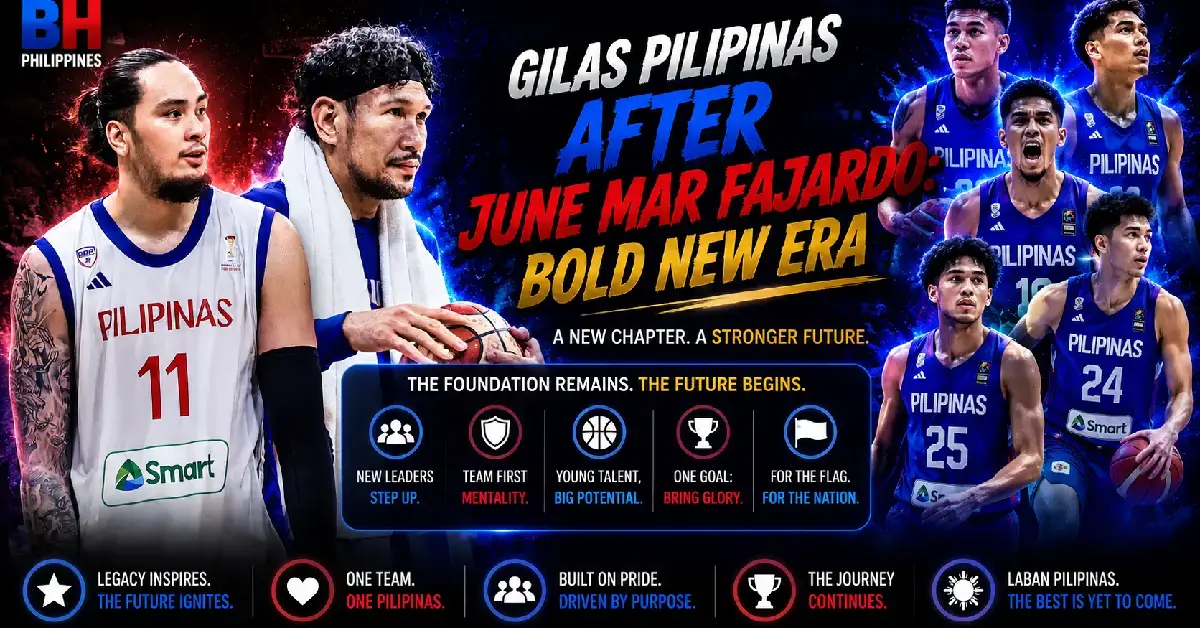
Gilas Pilipinas after June Mar Fajardo will look different, but the Philippines already has promising options for the center position. Kai Sotto and AJ Edu are the leading names in the conversation, while Quentin Millora-Brown and other versatile big men could provide additional depth.
Table of Contents
The transition became official in August 2026 when Fajardo ended his 13-year Gilas Pilipinas career. His final appearance came against Iran at the Mall of Asia Arena, where the Philippines won 68-56. Fajardo played seven minutes and five seconds, scoring six points and grabbing two rebounds. He finished his national-team career with 70 senior FIBA appearances.
That creates a major question for Philippine basketball: Who takes over the center role now?
There probably will not be one player who simply replaces everything Fajardo provided.
Instead, Gilas Pilipinas is likely to replace his production through a combination of size, athleticism, defensive versatility, rebounding, and different offensive roles.
The most important names are Kai Sotto and AJ Edu.
Who Takes Over for June Mar Fajardo on Gilas Pilipinas?
The clearest answer is Kai Sotto, but that does not mean Sotto automatically takes every minute at center.
Sotto brings something that is difficult to find in Philippine basketball: elite size. Listed at 7-foot-3, he gives Gilas a significantly different interior presence from most previous frontcourt options.
AJ Edu is another critical piece.
Edu is smaller than Sotto but offers mobility, defensive versatility, and the ability to operate as a modern big man. His skill set gives Gilas the option to defend more aggressively and play faster.
That means the post-Fajardo era may not be about finding another traditional bruising center.
It may be about building a more flexible frontcourt.
Gilas coach Tim Cone already had to manage this transition during 2026 because injuries and availability affected several big men. When the team prepared for the August World Cup qualifying window, Kai Sotto returned from injury while Edu also became available. GMA News reported that the two big men were reunited with Gilas for the first time since the 2023 FIBA World Cup.
That pairing could become one of the most important developments for Gilas Pilipinas after June Mar Fajardo.
Why Is Replacing June Mar Fajardo Such a Challenge?
Fajardo was not simply a center who occupied the five position.
He was an established veteran who understood international basketball, knew how to use his body around the basket, and had years of experience playing alongside the country’s best guards and forwards.
His value was also connected to familiarity.
Teammates knew where he liked the ball.
Coaches knew how he could be used in half-court offense.
Opponents knew his strengths, but they still had to deal with his size and post presence.
That type of chemistry cannot be created overnight.
Fajardo also provided continuity.
He debuted for Gilas in 2013 and eventually appeared in three FIBA World Cups. His career included major tournaments across more than a decade.
FIBA described him as one of the long-time cornerstones of the Philippine national team when it announced his retirement in 2026.
So the challenge is bigger than replacing his statistics.
Gilas must replace experience.
Can Kai Sotto Become Gilas Pilipinas’ New Starting Center?
Kai Sotto is the most obvious candidate.
His physical profile immediately changes how opponents have to attack Gilas.
At 7-foot-3, Sotto gives the Philippines considerable size around the rim. He can contest shots, rebound over smaller opponents, and create a target near the basket.
His offensive development is equally important.
Sotto does not have to become the next June Mar Fajardo.
In fact, that would probably be the wrong expectation.
The better approach is to maximize what makes Sotto different.
With Sotto on the floor, Gilas can create more vertical spacing around the paint. Guards can use his screens, while Sotto can roll toward the rim or establish position inside.
He can also give Gilas another option when opponents switch smaller defenders onto him.
However, there is an important consideration.
Sotto missed a significant stretch of national-team basketball because of an ACL injury suffered in January 2025. GMA reported that his return in August 2026 came after nearly two years away from Gilas duty.
That means the coaching staff should manage his workload carefully rather than immediately expecting him to replicate everything Fajardo did.
The good news is that Gilas does not need Sotto to be Fajardo.
It needs Sotto to be Sotto.
How Does AJ Edu Fit Into the New Gilas Frontcourt?
AJ Edu could be the most important complementary big man in the new Gilas rotation.
While Sotto provides exceptional size, Edu offers mobility.
That difference matters in modern FIBA basketball.
International opponents can punish slow defensive rotations, especially when centers are pulled away from the basket.
Edu’s ability to defend in space can help Gilas play more aggressive pick-and-roll coverage.
He can also run the floor and finish in transition.
That creates an interesting combination.
Sotto can provide size and interior presence.
Edu can provide mobility and defensive flexibility.
GMA News noted that Sotto and Edu had previously shown they could compete together at the 2023 FIBA World Cup in Manila before injuries interrupted their availability for the national team.
That makes their reunion particularly significant.
Rather than viewing Edu as Sotto’s backup, Gilas could potentially develop them as complementary frontcourt pieces.
Could Gilas Pilipinas Use a Two-Center Rotation?
Yes, and this may actually be the most practical solution.
The Philippine national team does not need to choose one permanent center and ignore the other.
Basketball is increasingly matchup-driven.
Against a large opponent, Sotto may provide the better interior matchup.
Against a faster team, Edu may become more valuable.
Against a team that plays small, Gilas could potentially use both.
A Sotto-Edu frontcourt could also allow the coaching staff to change defensive schemes without completely changing the lineup.
That flexibility is valuable in FIBA competition.
The bigger question is whether both players can consistently stay healthy and available.
If they can, Gilas could move from a traditional single-center model toward a more versatile frontcourt rotation.
What Role Could Quentin Millora-Brown Play?
Quentin Millora-Brown should not be overlooked.
He provides another legitimate big-body option for Gilas.
His role could become particularly important during qualifying windows when injuries, club commitments, and player availability affect the roster.
In August 2026, Millora-Brown was dealing with a back issue, while other frontline players were also unavailable. Manila Bulletin reported that those absences left Edu as the only legitimate center available at one stage of the preparation.
That situation showed exactly why frontcourt depth matters.
Gilas cannot rely on two players alone.
A long international calendar requires multiple options.
Millora-Brown can therefore serve as an important rotational piece when available, giving Cone another physical presence at center.
He does not have to become the next Fajardo.
He simply needs to make the rotation deeper and more dependable.
Could Justine Baltazar Help Replace Fajardo’s Frontcourt Minutes?
Justine Baltazar offers another intriguing option.
Baltazar is not a direct replacement for Fajardo either.
Instead, his value comes from positional versatility and his ability to play in different lineup combinations.
Gilas used Baltazar during the 2026 World Cup qualifying cycle as part of its effort to strengthen the frontcourt.
The Philippine News Agency reported that Baltazar, Mike Phillips, and Troy Rosario were brought into the roster to reinforce the frontline during the July qualifying window.
That illustrates a broader point.
The post-Fajardo Gilas frontcourt does not have to be built entirely around traditional centers.
The Philippines can use bigger forwards alongside true centers and create different matchup problems.
What Changes for Gilas Pilipinas After June Mar Fajardo?
The biggest change will be stylistic.
Fajardo’s game was built around strength, positioning, screening, rebounding, and interior scoring.
The next Gilas generation can introduce more mobility.
Sotto brings size.
Edu brings athleticism.
Other forwards can provide shooting and switchability.
That combination could make Gilas more adaptable.
The team may also become more comfortable playing five-out or four-out offensive sets, depending on the personnel available.
The key is not to force the new roster to imitate the previous one.
Successful teams evolve.
Gilas has already gone through multiple roster changes during the modern era.
The departure of one veteran does not mean the end of the team’s identity.
It means the identity can change.
Will Gilas Still Play Through the Post?
Probably, but not in exactly the same way.
Sotto gives Gilas a reason to continue using interior offense.
However, the modern game requires more than feeding the center on every possession.
The center must screen.
He must roll.
He must pass.
He must defend pick-and-rolls.
He must rebound.
And, ideally, he should create opportunities for perimeter players.
This is where Sotto and Edu can provide different solutions.
Instead of relying heavily on low-post isolations, Gilas can use its centers as screeners and hubs.
That could create more driving lanes for guards such as RJ Abarrientos and Dwight Ramos while giving shooters better opportunities around the perimeter.
The result could be a more balanced offensive attack.
What Does the New Frontcourt Mean for Gilas’ Defense?
This could be the most exciting part of the transition.
Fajardo’s size and physicality were valuable, but international basketball increasingly demands centers who can survive multiple actions.
Edu’s mobility gives Gilas a chance to defend pick-and-rolls differently.
Sotto’s length can provide rim protection.
A combination of both gives the coaching staff options.
The Philippines could potentially defend with more aggressive help while still having a large player protecting the paint.
Of course, execution matters more than potential.
The new frontcourt will have to improve communication, defensive rebounding, transition defense, and rotations.
The talent is there.
The system will determine how effectively it is used.
Is Gilas Pilipinas’ Future Frontcourt Strong Enough?
The answer is encouraging.
Gilas does not have another June Mar Fajardo waiting to step into the same role.
But it may not need one.
Sotto provides extraordinary size.
Edu provides mobility.
Millora-Brown offers another center option.
Baltazar and other versatile forwards can provide additional lineup flexibility.
That creates a deeper range of possibilities than simply searching for a one-for-one replacement.
The biggest concern is availability.
Philippine basketball has seen several recent examples of frontline players missing national-team windows because of injury or other commitments.
That is why depth will be one of the most important priorities for the next Gilas cycle.
What Should Gilas Pilipinas Do Next?
The first priority should be developing chemistry.
Sotto and Edu need repetitions together.
They need to learn each other’s tendencies.
They need to establish defensive communication.
The guards need to understand where Sotto wants the ball.
The coaching staff needs to determine which combinations work best against different opponents.
The second priority should be developing a clear identity.
Gilas should not attempt to recreate the Fajardo era.
Instead, the team should build around the strengths of its current generation.
The third priority is maintaining frontcourt depth.
If Sotto is unavailable, Gilas needs a reliable alternative.
If Edu is unavailable, another player must be capable of handling international minutes.
That is why players such as Millora-Brown, Baltazar, and other developing bigs remain important.
Finally, Gilas should continue blending veterans and younger players.
Fajardo’s retirement is the end of one chapter, but it also creates opportunities for the next generation.
Why June Mar Fajardo’s Departure Could Actually Help the Next Generation
It is easy to view retirement as a loss.
And it is one.
But national teams also need succession.
Fajardo himself recognized that point.
After 13 years of national-team service, he said goodbye while younger players were preparing to take on larger responsibilities.
His final game was especially symbolic because it happened at the same venue where he first represented the Philippines internationally.
The Philippines defeated Iran 68-56, and Fajardo finished his final Gilas appearance with six points and two rebounds.
He received the game ball after the victory.
It was an appropriate ending.
Now the spotlight moves to Sotto, Edu, and the next wave of Filipino big men.
Their challenge is not to become June Mar Fajardo.
Their challenge is to create their own era.
What Could Gilas Pilipinas Look Like in the Next Few Years?
The potential lineup combinations are fascinating.
A Sotto-Edu frontcourt could give Gilas both size and mobility.
A Sotto-heavy lineup could emphasize interior offense and rim protection.
An Edu-centered lineup could allow more switching and faster defensive rotations.
A smaller lineup with versatile forwards could create additional spacing.
The coaching staff therefore has more than one path.
That is valuable.
It also means the post-Fajardo period should be viewed as a transition rather than a decline.
Gilas Pilipinas has lost an iconic veteran.
But it has gained an opportunity to build around a younger frontcourt with different physical and tactical characteristics.
The next generation will determine whether that opportunity becomes a strength.
Conclusion
Gilas Pilipinas after June Mar Fajardo enters a new era with a very different frontcourt.
Fajardo’s 13-year national-team career provided consistency, experience, physicality, and leadership. He represented the Philippines in three FIBA World Cups and finished with 70 senior FIBA appearances before retiring from international basketball in 2026.
The next chapter will not be about finding another Fajardo.
It will be about building around Kai Sotto, AJ Edu, and the next generation of Gilas big men.
Sotto offers exceptional size.
Edu offers mobility and defensive versatility.
Millora-Brown can add depth.
Baltazar and other versatile forwards can give the coaching staff additional lineup options.
That combination creates reasons for optimism.
The transition will not be automatic. Injuries, player availability, international matchups, and chemistry will all influence the rotation.
But the Philippines has the personnel to build something new.
The most important question is no longer who can replace June Mar Fajardo exactly.
It is what Gilas Pilipinas after June Mar Fajardo can become.
And that may ultimately be the more exciting question for Filipino basketball fans.
Join the Discussion
Be part of the conversation surrounding Gilas Pilipinas after June Mar Fajardo! Follow BasketballHubPH on our social media for the latest Philippine basketball news, Gilas Pilipinas updates, player stories, and basketball discussions.
You can also visit the BasketballHubPH online store for basketball-inspired T-shirts, jerseys, wall art, and other general merchandise for Filipino basketball fans.
Who should take the biggest role in the new Gilas frontcourt: Kai Sotto, AJ Edu, or another Filipino big man? Share your thoughts and join the discussion with fellow Philippine basketball fans!
Frequently Asked Questions
Who will replace June Mar Fajardo on Gilas Pilipinas?
There is no single official replacement who duplicates Fajardo’s role. Kai Sotto and AJ Edu are the leading frontcourt options, with Quentin Millora-Brown and other big men providing potential depth.
Is Kai Sotto the new Gilas Pilipinas starting center?
Sotto is the leading candidate to take on a major center role because of his 7-foot-3 size and international experience. However, starting lineups will depend on the opponent, player availability, health, and Tim Cone’s tactical decisions.
Can AJ Edu and Kai Sotto play together?
Yes. They previously played together for Gilas, including at the 2023 FIBA World Cup. Their different skill sets could make them complementary rather than competing options.
What happens to Gilas’ playing style after June Mar Fajardo?
Gilas could become more versatile. Instead of relying as heavily on a traditional post-up center, the team can combine Sotto’s size, Edu’s mobility, and versatile forwards to create different offensive and defensive looks.
Is Gilas Pilipinas’ frontcourt still strong without June Mar Fajardo?
It has the potential to remain strong. Fajardo’s experience will be difficult to replace, but Sotto, Edu, Millora-Brown, Baltazar, and other developing bigs give the Philippines several ways to build the next frontcourt rotation.