

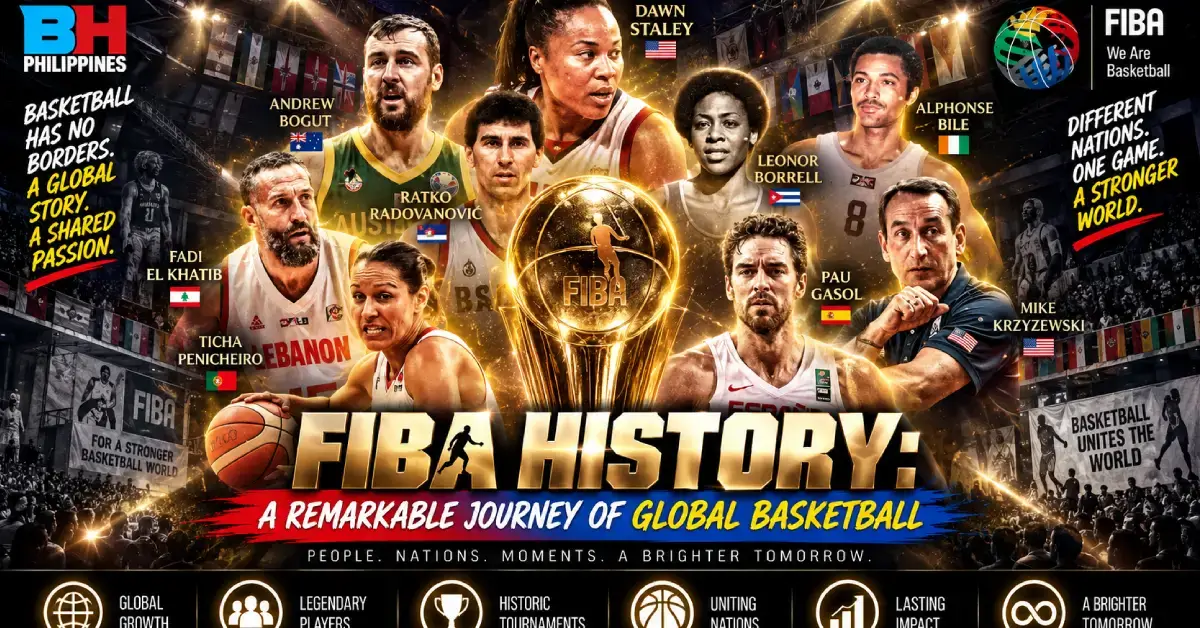
What is the history of FIBA? FIBA, the International Basketball Federation, was founded on June 18, 1932, by eight national basketball federations that wanted a unified international organization for the sport. Since then, FIBA has helped transform basketball from a growing international game into a global sport with major national-team competitions, Olympic basketball, World Cups, women’s basketball, youth tournaments, and 3×3.
The story of FIBA history is therefore much bigger than the FIBA Basketball World Cup. It is the story of how countries began playing basketball under common international rules and how national teams eventually turned the sport into a worldwide competition.
Table of Contents
For Filipino basketball fans, FIBA basketball history is especially relevant. The Philippines has been involved in major FIBA competitions for decades, hosted the 1978 World Championship and co-hosted the 2023 FIBA Basketball World Cup.
What is FIBA and why was it created?
FIBA was created to give international basketball a central governing body.
Before FIBA existed, basketball was already spreading beyond its birthplace in the United States. However, international competition needed organization, common rules, and cooperation between national federations.
Eight national federations founded FIBA in Geneva, Switzerland: Argentina, Czechoslovakia, Greece, Italy, Latvia, Portugal, Romania, and Switzerland. The founding meeting also established the organization’s first bylaws and unified playing rules.
That decision changed the future of basketball.
Instead of countries developing completely separate approaches to international competition, FIBA provided a framework that allowed national teams to compete against each other.
The organization also created a pathway for basketball to grow through continental competitions and eventually the Olympic Games and World Cup.
When was FIBA founded?
FIBA was officially founded on June 18, 1932.
The organization was originally known as the Fédération Internationale de Basketball Amateur, reflecting the amateur structure of international basketball at the time. Its founding came only a few decades after James Naismith invented basketball in 1891.
The eight founding federations were important because they demonstrated that basketball was already becoming an international sport.
FIBA’s creation also came at a crucial stage in the sport’s development. International basketball needed standardized rules and a body capable of organizing competitions across national borders.
The organization eventually became responsible for some of the most important competitions in the sport.
Today, FIBA’s global headquarters is the House of Basketball in Mies, Switzerland. FIBA’s official overview lists 1932 as its founding year and identifies the 1950 men’s World Cup and 1953 women’s World Cup as early landmarks.
How did basketball become an Olympic sport?
One of the most important early developments in FIBA basketball history happened in 1936.
Basketball was included as an Olympic sport for the first time at the Berlin Olympic Games.
That achievement was particularly significant because international basketball had been developing for only a few decades.
The Olympic tournament helped establish basketball as a legitimate global competitive sport.
FIBA’s historical timeline records the 1936 Berlin Games as the first Olympic appearance for basketball.
The Olympic stage also helped accelerate the international growth of the sport.
National teams could now compete for an Olympic medal, creating a new level of prestige beyond regional competitions.
For many countries, representing their nation at the Olympics became one of the biggest goals in basketball.
The Olympic connection would become even more important decades later when professional players were allowed to compete.
When did the FIBA World Cup begin?
The FIBA World Cup history officially began in 1950.
The first tournament was held in Buenos Aires, Argentina, from October 22 to November 4.
At the time, the competition was called the FIBA World Championship for Men rather than the FIBA Basketball World Cup.
Ten teams participated in the inaugural tournament.
Argentina won the championship on home soil, defeating the United States 64–50 in the final. Oscar Furlong was named the tournament’s Most Valuable Player.
The first World Championship was very different from today’s World Cup.
The tournament had fewer teams, different qualification procedures, and a much less developed international basketball infrastructure.
Yet its basic purpose was familiar: bring the best national teams together to determine a world champion.
That idea became the foundation for one of basketball’s most important international competitions.
How did the FIBA World Cup evolve?
The World Cup changed dramatically over the decades.
The second tournament was held in Brazil in 1954, followed by Chile in 1959 and Brazil again in 1963. The competition continued through different continents and gradually expanded its global reach.
The tournament also became a showcase for different basketball styles.
European teams developed sophisticated team-oriented systems.
South American nations became known for skill and creativity.
The United States eventually became a dominant force, particularly after major changes to player eligibility.
The former Yugoslavia and Soviet Union also became major powers during different periods.
According to FIBA’s historical records, the World Cup has been won by only a select group of nations. The United States and former Yugoslavia each won five titles, while the former Soviet Union won three. Brazil and Spain each won twice, while Argentina has one championship.
The Philippines also holds a special place in FIBA World Cup history.
The country hosted the 1978 tournament in Manila, making it the first Asian nation to host the World Championship.
The Philippines later co-hosted the 2023 FIBA Basketball World Cup alongside Japan and Indonesia.
How did women’s basketball become part of FIBA’s global story?
The history of FIBA is not only about men’s basketball.
Women’s international basketball developed alongside the men’s game.
FIBA organized the first Women’s World Championship in 1953 in Santiago, Chile. The Soviet Union won the inaugural tournament.
Women’s basketball continued expanding through international championships and the Olympic Games.
The first women’s Olympic basketball tournament was held at the 1976 Montreal Olympics.
That was another important milestone because it gave women’s national teams a major global stage.
Over time, FIBA’s competitions for women expanded through senior tournaments, youth championships, continental events, and other development programs.
This parallel development is an important part of FIBA basketball history because the organization has helped create international opportunities for both men’s and women’s basketball.
When did professional players enter FIBA competitions?
One of the biggest changes in the history of FIBA came in 1989.
FIBA’s World Congress decided to remove the distinction between amateur and professional players, making professional basketball players eligible for FIBA competitions.
That decision changed international basketball forever.
Before the rule change, the Olympic tournament had restrictions that prevented NBA players from competing.
The most famous result came at the 1992 Barcelona Olympics.
For the first time, NBA players were allowed to participate in the Olympic men’s basketball tournament.
The United States assembled the legendary team known as the “Dream Team,” featuring stars such as Michael Jordan, Magic Johnson, Larry Bird, Charles Barkley, Patrick Ewing, and David Robinson.
The team’s dominance helped create enormous global attention for international basketball.
But the impact went beyond one American roster.
Professional players from other countries could also increasingly represent their national teams, accelerating the development of international basketball talent.
European, Latin American, African, and Asian players gained greater exposure to elite competition.
How did FIBA expand basketball around the world?
The history of FIBA is also a story of geographic expansion.
FIBA developed regional structures across Africa, the Americas, Asia, Europe, and Oceania.
This allowed basketball development to take place closer to individual national federations while maintaining a global framework.
Continental competitions became important pathways to World Cup and Olympic qualification.
For Asian basketball, FIBA Asia competitions became a major stage for countries such as the Philippines, China, Japan, Korea, Iran, and Australia.
The Philippines has been particularly important to Asian basketball history.
The country hosted the inaugural FIBA Asia Championship in 1960 and won the tournament. The Philippines also captured Asian titles in 1963, 1967, 1973, and 1986.
Those achievements show why FIBA’s international structure matters so much to Filipino fans.
It created regular competitions where the Philippine national team could test itself against the strongest teams in Asia.
What changed with the modern FIBA World Cup?
The modern FIBA World Cup is much larger than the original 1950 tournament.
The 2019 World Cup in China featured 32 teams, a major increase from the 10-team inaugural event. FIBA described the expansion as part of the tournament’s transformation into a truly global competition.
The qualification system also changed.
Instead of relying solely on a short tournament qualification process, FIBA introduced qualification windows that allowed national teams to compete throughout an extended cycle.
This created more meaningful international games and gave developing basketball nations additional opportunities to compete.
The World Cup was renamed from the FIBA World Championship to the FIBA Basketball World Cup beginning with the 2014 edition.
The name change reflected the event’s growing global identity.
Why was the 2023 World Cup important for the Philippines?
The 2023 FIBA Basketball World Cup was especially important for Filipino basketball fans.
The Philippines was one of three co-hosts, alongside Japan and Indonesia.
It was the first time the World Cup was staged across three countries. The tournament featured 32 teams and 92 games.
Manila became one of the main centers of the tournament.
The Philippines hosted games at the Mall of Asia Arena and attracted huge crowds throughout the competition.
For the Philippine national team, playing at home created enormous expectations.
Gilas Pilipinas faced the Dominican Republic, Angola, and Italy in the group stage. Although the Philippines did not advance to the second round, the tournament remained a major event in Philippine basketball history.
The 2023 World Cup also demonstrated how far FIBA competitions had evolved.
A tournament that began with only 10 teams in Buenos Aires had become a 32-team global event involving multiple host countries.
How did 3×3 become part of FIBA history?
Another important modern development is 3×3 basketball.
FIBA has promoted 3×3 as a faster, more accessible form of basketball that can be played on a half court with three players per team.
The discipline grew rapidly through FIBA competitions and eventually reached the Olympic Games.
3×3 made its Olympic debut at the Tokyo 2020 Games, which were held in 2021 after being postponed because of the COVID-19 pandemic.
This was significant because it demonstrated that FIBA was not simply preserving traditional five-on-five basketball.
It was also developing new formats that could attract younger players and expand basketball’s reach.
The shorter games, smaller playing area, and relatively simple setup make 3×3 especially suitable for urban environments.
For countries with limited access to full basketball facilities, that can be an important development pathway.
Why does FIBA matter to Philippine basketball?
FIBA matters enormously to the Philippines because international competition is central to the country’s basketball identity.
The Philippines has participated in FIBA competitions for decades.
The national team reached the podium at the 1954 World Championship, finishing third. FIBA records show the Philippines’ third-place finish remains a unique achievement for an Asian men’s national team at the World Cup level.
The Philippines also hosted the 1978 World Championship.
That tournament remains one of the biggest international basketball events ever staged in the country before the 2023 World Cup.
Modern Gilas Pilipinas has continued the tradition.
The national team qualified for the 2014 World Cup after its strong performance at the 2013 FIBA Asia Championship.
Gilas then returned to the World Cup in 2019 and competed in the 2023 edition on home soil.
The country’s involvement demonstrates how FIBA basketball history and Philippine basketball history are closely connected.
What are some of the biggest milestones in FIBA history?
Several dates provide a useful timeline for understanding the organization.
1932: FIBA is founded in Geneva by eight national federations.
1936: Basketball makes its Olympic debut in Berlin.
1950: The first men’s FIBA World Championship takes place in Buenos Aires, with Argentina winning the title.
1953: The first Women’s World Championship is held in Santiago.
1976: Women’s basketball makes its Olympic debut.
1989: FIBA removes the amateur-professional distinction for its competitions.
1992: Professional players participate in Olympic basketball in Barcelona.
2014: The FIBA World Championship era transitions to the modern FIBA Basketball World Cup branding.
2019: The World Cup expands to a 32-team tournament in China.
2021: 3×3 basketball makes its Olympic debut in Tokyo.
2023: The Philippines, Japan, and Indonesia co-host the FIBA Basketball World Cup.
This timeline shows how dramatically international basketball has changed in less than a century.
What makes FIBA World Cup history so important?
The FIBA World Cup history provides a record of how international basketball developed.
Early tournaments were relatively small.
Modern editions involve dozens of national teams, global broadcasting, international stars, sophisticated coaching systems, and enormous fan bases.
The tournament has also become an important development pathway.
A strong World Cup performance can establish a country’s basketball program on the international stage.
For players, the tournament offers an opportunity to compete against the best national teams in the world.
For fans, it creates matchups that would rarely happen in ordinary club basketball.
The World Cup also provides a fascinating record of basketball’s tactical evolution.
Early international games were generally slower and more physical.
Modern FIBA basketball features greater spacing, three-point shooting, pick-and-roll offense, switching defense, and positionless lineups.
The evolution of the competition reflects the evolution of the sport itself.
What does the future of FIBA look like?
The future of FIBA will likely focus on making international basketball more competitive, accessible, and global.
National-team competitions remain central to FIBA’s strategy, while youth development and 3×3 continue to expand.
The organization has also placed greater emphasis on developing basketball in countries that have not traditionally been major powers.
That matters because international basketball becomes stronger when more nations can produce competitive teams.
For Philippine basketball, the opportunity is significant.
The country has a passionate fan base, a deep basketball culture, professional leagues, strong collegiate programs, and a long FIBA tradition.
The challenge is converting that passion into sustained international success.
That means developing young players, improving grassroots coaching, building elite training systems, and giving national-team players more opportunities to compete against different styles.
The next chapters of FIBA history will be written by these emerging basketball nations as much as by the traditional powers.
Conclusion: Why FIBA History Matters
FIBA history is the story of basketball becoming a truly international sport.
From eight founding federations in 1932 to today’s worldwide basketball structure, FIBA has played a central role in organizing national-team competition and creating pathways for basketball players around the globe.
The first World Championship in 1950 eventually developed into today’s FIBA Basketball World Cup. Basketball became an Olympic sport in 1936, professional players entered FIBA competitions after the 1989 eligibility change, and 3×3 eventually reached the Olympics.
For Filipino fans, this history has a special connection.
The Philippines has competed at major FIBA tournaments, finished third at the 1954 World Championship, hosted the 1978 event, and helped stage the 2023 World Cup.
Understanding FIBA basketball history therefore means understanding an important part of Philippine basketball history too.
And the story is far from finished.
Join the Discussion
FIBA history shows how basketball grew from a relatively young sport into a global game connecting national teams and fans across continents. Which FIBA moment or tournament is your favorite, and what do you think is the most important chapter in international basketball history? Share your thoughts with fellow Filipino basketball fans, follow Basketball Hub PH on Facebook and Instagram, and visit our store for general basketball merchandise, including Basketball T-Shirts, Basketball Wall Art, jerseys, and more.
Frequently Asked Questions
When was FIBA founded?
FIBA was founded on June 18, 1932, in Geneva, Switzerland, by eight national basketball federations.
When was the first FIBA World Cup?
The first men’s FIBA World Championship was held in Buenos Aires, Argentina, in 1950. Argentina won the inaugural tournament by defeating the United States in the final.
When did basketball become an Olympic sport?
Basketball made its first Olympic appearance at the 1936 Berlin Games.
When did the FIBA World Championship become the World Cup?
The men’s competition was known as the FIBA World Championship from 1950 through 2010. It adopted the FIBA Basketball World Cup name beginning with the 2014 edition.
Why is FIBA important to Philippine basketball?
FIBA provides the international competition structure through which the Philippine national basketball team competes against teams from Asia and the rest of the world. The Philippines has a long FIBA history, including a third-place finish at the 1954 World Championship and hosting the 1978 and 2023 World Cups.