
How did the PBA begin?
The PBA history began in 1975 when the Philippine Basketball Association was established as the country’s first professional basketball league. Its creation gave elite Filipino basketball players a professional competition of their own and marked a major turning point in the development of basketball in the Philippines. The league was formed during a period when basketball already had deep roots in Filipino sports culture, making the PBA’s arrival a natural next step in the country’s basketball story. FIBA recognizes 1975 as the year the PBA was founded and places its emergence within a much longer Philippine basketball tradition.
More than five decades later, the PBA has become one of the most recognizable basketball institutions in the Philippines. Its history includes legendary players, powerful franchises, memorable championship series, iconic coaches, imports, rivalries, dramatic comebacks, and generations of fans.
Table of Contents
Understanding the history of PBA therefore means understanding more than when the league started. It means looking at why professional basketball became necessary, how the league developed, and why the PBA became such an important part of Filipino basketball culture.
For Filipino fans, the PBA is not simply another basketball competition. It is a connection between generations. Parents and grandparents can remember stars from earlier decades, while younger fans can follow today’s players and compare them with the legends who came before.
What was Philippine basketball like before the PBA?
To understand the Philippine Basketball Association history, it is important to look at the country’s basketball tradition before 1975.
Basketball arrived in the Philippines around the beginning of the 20th century and gradually became deeply embedded in Filipino life. The YMCA played an important role in popularizing the sport, while organized school and collegiate basketball helped develop the country’s basketball culture.
The Philippines also developed a strong international basketball reputation long before the PBA was established.
The country competed successfully in international tournaments and built a reputation as one of Asia’s strongest basketball nations. The Philippines won the inaugural Asian Basketball Championship in 1960 and later captured additional Asian titles in 1963, 1967, 1973, and 1986.
That background is important.
The PBA did not create Filipino basketball enthusiasm from nothing. Instead, it emerged from an already established basketball culture.
By the 1970s, basketball had become deeply connected to schools, communities, commercial competitions, and national sports identity. Filipino players had already developed considerable experience playing organized basketball.
The next step was creating a professional league where elite players could compete at the highest domestic level.
Why was the PBA founded in 1975?
The creation of the PBA reflected the growing popularity and commercial potential of basketball in the Philippines.
Before the league’s formation, talented Filipino players could compete in major amateur and commercial competitions, but there was no established professional league comparable to the professional basketball structures developing elsewhere.
The PBA changed that.
Its formation gave players a formal professional platform while giving businesses an opportunity to support basketball teams and connect their brands with one of the country’s most popular sports.
That relationship between basketball and business became one of the defining characteristics of the PBA.
Corporate-backed franchises became an important part of the league’s identity, and company names became familiar to generations of basketball fans.
The result was a professional competition that combined elite basketball with strong commercial support.
FIBA’s account of Philippine basketball identifies the founding of the PBA in 1975 as a significant milestone in the country’s basketball development. The organization also notes that the Philippines was awarded the rights to host the 1978 FIBA World Championship within months of the PBA’s establishment, showing how important basketball had become internationally for the country.
Who were the original PBA teams?
The original PBA lineup consisted of nine teams that came from the country’s established commercial basketball scene.
The founding franchises were Crispa Redmanizers, Toyota Comets, U/Tex Wranglers, Mariwasa-Noritake Porcelainmakers, Tanduay Distillers, Carrier Weathermakers, Filmanbank, Royal Tru-Orange, and CFC.
These teams immediately created some of the personalities and rivalries that would define early PBA history.
The presence of Crispa and Toyota was particularly important.
Both franchises quickly became major forces in the league, and their rivalry developed into one of the defining stories of early professional basketball in the Philippines.
The PBA’s corporate-team structure also made it different from many modern sports leagues.
Fans often associated teams with the companies behind them, while players became the recognizable stars who represented those brands on the court.
This connection between business and basketball would remain an important part of the league for decades.
What happened during the PBA’s first season?
The PBA officially began playing in April 1975.
Its first game was held at the Araneta Coliseum in Quezon City, a venue that would become closely associated with Philippine basketball history.
The league’s first season featured three conferences, giving the new professional competition a structure that differed from the modern PBA format.
The first PBA championship was won by Toyota.
That immediately established Toyota as one of the league’s early powerhouse franchises.
The importance of that first season goes beyond the championship itself.
The PBA had demonstrated that professional basketball could attract fans, corporate investment, elite players, and sustained public interest.
The league had created something that could continue beyond a single season.
That foundation became the starting point for more than five decades of Philippine professional basketball.
How did Crispa and Toyota shape PBA history?
Few rivalries are more important to the early history of PBA than Crispa versus Toyota.
The two franchises became the league’s dominant teams during its formative years.
Crispa developed a powerful identity around stars such as Atoy Co, Bogs Adornado, Philip Cezar, and Freddie Webb, while Toyota featured legends including Robert Jaworski, Francis Arnaiz, Ramon Fernandez, and others.
Their rivalry was about more than individual games.
It represented two powerful basketball organizations competing for championships while their star players became household names.
Robert Jaworski, in particular, would become one of the most influential personalities in Philippine basketball. His playing career, leadership, and later coaching career helped make him one of the sport’s most recognizable figures.
Toyota eventually left the PBA in 1984, while Crispa also departed the league in the same period.
Their franchises did not last forever, but their impact remained.
Many of the traditions, rivalries, personalities, and fan memories created during that era became part of the league’s permanent identity.
Why was the 1980s important in the history of PBA?
The 1980s were a crucial period in Philippine professional basketball.
The league continued to develop its competitive structure while new franchises and stars emerged.
One of the most significant developments was the rise of San Miguel Beer.
The San Miguel franchise eventually became one of the most successful organizations in PBA history, building a championship tradition that would continue for decades.
The decade also saw the emergence of players who would become household names across the country.
The PBA increasingly became part of everyday Filipino sports culture.
Games were followed on television, discussed in workplaces and schools, and debated among friends and families.
Basketball conversations were no longer limited to who won a particular game.
Fans debated which players were the best shooters, strongest rebounders, smartest point guards, toughest defenders, and most clutch performers.
That growing conversation helped transform the PBA from a new professional league into a lasting sports institution.
How did the PBA develop its championship structure?
The PBA’s competition format has changed many times throughout its history.
Rather than simply running one long regular season followed by one championship playoff, the league developed a conference-based structure.
Different conferences have used different names and formats over the decades, but the basic idea has remained familiar to Filipino fans: teams compete for conference championships, with imports and roster rules sometimes changing depending on the tournament.
This structure helped create multiple championship opportunities within a single PBA season.
It also gave franchises additional chances to recover after a disappointing conference.
A team that struggled in one tournament could rebuild, adjust its lineup, change its import, or improve its system before the next conference.
This made the PBA season more dynamic.
It also created a rich championship history.
When looking at the Philippine Basketball Association history, it is important to remember that the league’s championship records reflect many different eras and tournament structures.
That is why historical PBA statistics should always be considered alongside the format used during the period being studied.
What role did imports play in PBA history?
Imports have played an important role in the development of Philippine professional basketball.
PBA conferences have often allowed teams to bring in foreign players to strengthen their lineups.
These imports introduced Filipino fans to different playing styles and provided local players with opportunities to compete against international talent.
Some imports became major personalities in the Philippines.
They were not simply temporary players.
Many became remembered as part of a franchise’s championship story, especially when they delivered dominant scoring, rebounding, shot-blocking, or playmaking performances during the playoffs.
The import system also influenced the style of basketball played in the PBA.
A dominant big man could change how a team defended the paint.
A high-scoring guard could transform an offense.
A versatile forward could create matchup problems.
Local players had to adjust to these different styles, helping make the PBA a valuable competitive environment.
At the same time, the league has continually adjusted its import rules and eligibility requirements to balance the contribution of imports with opportunities for Filipino players.
How did the PBA become part of Filipino basketball culture?
The biggest reason the PBA survived for decades is that basketball was already deeply embedded in Philippine culture.
Basketball courts can be found in communities across the country.
Children grow up playing pickup games, school competitions, barangay tournaments, and organized leagues.
For many Filipinos, following professional basketball becomes a natural extension of playing the sport themselves.
The PBA gave those fans local professional heroes.
Instead of following only international players, Filipino fans could watch homegrown stars compete in a professional league.
This created a powerful connection between players and supporters.
A player could become associated with a particular province, school, company, or generation of fans.
That connection is one of the most important parts of PBA history.
The league became more than entertainment.
It became a way for Filipinos to share basketball conversations across generations.
Which PBA teams became the most successful franchises?
Several organizations have established themselves as major powers in the league.
San Miguel Beer is among the most successful franchises in PBA history.
Crispa and Toyota dominated the early years.
Alaska became one of the defining teams of the 1990s and is remembered for its sustained success and Grand Slam season.
Barangay Ginebra developed one of the strongest fan bases in Philippine sports and became particularly famous for its passionate supporters and memorable playoff battles.
Purefoods and its successor franchises also became major championship contenders.
Talk ‘N Text and other corporate-backed teams later established themselves as consistent forces.
Each successful franchise contributed something different to the history of PBA.
Some were defined by dynasties.
Others were defined by iconic players.
Some became famous because of their fan bases.
Others built their reputation through coaching, player development, and organizational consistency.
What is a PBA Grand Slam?
One of the most prestigious achievements in PBA history is winning all three major conference championships in a single season.
This accomplishment is commonly known as a Grand Slam.
Only a small number of teams have achieved it.
Crispa completed the feat in 1976 and again in 1983. San Miguel Beer accomplished it in 1989, while Alaska achieved the Grand Slam in 1996. FIBA has documented these four occasions as the league’s historic Grand Slam seasons.
The difficulty of the achievement explains its importance.
Winning one championship is difficult.
Winning multiple championships during a season requires an organization to maintain a high level of performance while opponents continually adjust.
A team also has to manage fatigue, injuries, roster changes, and the different challenges created by each conference.
That makes the Grand Slam one of the clearest symbols of sustained dominance in Philippine professional basketball.
How did coaching influence PBA history?
Great players receive much of the attention, but coaches have played an equally important role in shaping the league.
Coaches have had to adapt to changing player generations, tactical trends, conference rules, import systems, and roster construction.
Some became famous for defensive systems.
Others emphasized fast-break basketball.
Some preferred half-court execution and post play.
Others built offenses around perimeter shooting and pick-and-roll actions.
Tim Cone is one of the most successful coaches in PBA history and became particularly associated with championship success and the Grand Slam.
Norman Black also became a major figure in the league, winning multiple championships as a coach and contributing to the development of several successful teams. The PBA has documented Black reaching 701 career coaching victories, placing him among the league’s all-time coaching leaders.
The influence of coaches demonstrates that the Philippine Basketball Association history is not simply a story of superstar players.
It is also a story of basketball systems.
How has the PBA changed with modern basketball?
Modern basketball has become faster, more perimeter-oriented, and increasingly influenced by analytics.
The PBA has evolved alongside these changes.
Three-point shooting has become more important.
Spacing has become a bigger part of offensive strategy.
Guards are expected to create shots while also defending multiple positions.
Big men increasingly need to pass, screen, defend pick-and-rolls, and sometimes stretch the floor.
At the same time, traditional basketball skills remain important.
Rebounding still wins possessions.
Defense still determines playoff series.
Ball movement still creates open shots.
Free-throw shooting remains important in close games.
The PBA’s ability to adapt while retaining its traditional basketball identity has helped it remain relevant.
Why is PBA history important to Filipino basketball fans?
Studying PBA history helps fans understand where Philippine professional basketball came from.
Today’s players are part of a much longer tradition.
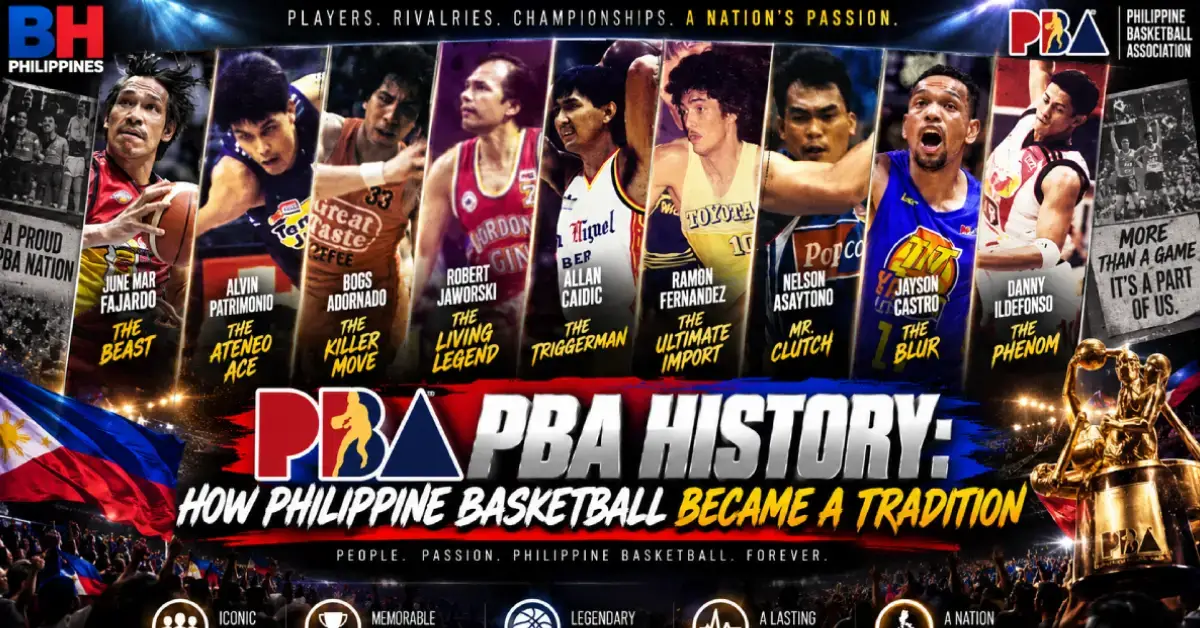
Modern PBA stars inherited a basketball culture shaped by players such as Robert Jaworski, Ramon Fernandez, Atoy Co, Bogs Adornado, Philip Cezar, Alvin Patrimonio, Benjie Paras, Allan Caidic, Johnny Abarrientos, James Yap, June Mar Fajardo, and many others.
Each generation added something to the league.
Some became famous for scoring.
Others became defensive specialists.
Some were elite passers.
Others were dominant centers.
Some became championship leaders.
The history also shows how the game itself changed.
The physical style of earlier decades differs from today’s more perimeter-oriented approach.
Yet the basic competitive values remain familiar: execute the game plan, defend, rebound, share the ball, make shots, and perform under pressure.
What can today’s fans learn from Philippine Basketball Association history?
The biggest lesson from the history of PBA is that basketball success is rarely created overnight.
Successful franchises usually combine talented players with strong coaching, smart roster decisions, player development, and organizational stability.
The same principle applies outside professional basketball.
Young players can learn from the work ethic of previous generations.
Coaches can study how different systems succeeded.
Fans can understand why certain players became legends.
And basketball communities can appreciate how the sport became such an important part of Philippine culture.
PBA history also teaches fans to appreciate different styles of greatness.
A high-scoring guard and a defensive center can both become legends.
A superstar can receive the headlines while a role player makes the championship-winning defensive play.
A coach can change the direction of an organization without ever scoring a point.
That variety is what makes basketball history worth studying.
How can PBA history be kept accurate and easy to update?
A good historical basketball article should separate permanent facts from information that may change.
The founding date and early history are permanent.
Current team rosters, active players, coaches, championship totals, and ongoing records can change.
For this reason, an article about PBA history should include clear dates and avoid mixing current information with historical facts without context.
When updating the article, editors should verify championship records, franchise names, player statistics, and major league developments against authoritative PBA or FIBA material.
This makes the article useful both as an introduction for new fans and as a reference for longtime followers.
It also prevents one common problem with historical sports content: allowing an old statistic or outdated team name to remain uncorrected for years.
Why does the PBA remain important today?
The PBA remains important because it connects professional basketball with Filipino sports culture.
The league has survived changes in entertainment, television, social media, player development, and basketball tactics.
Its audience has also changed.
Older fans may remember Crispa, Toyota, and the early Araneta Coliseum battles.
Fans from another generation may remember Alaska, Purefoods, San Miguel, Ginebra, and the great stars of the 1990s and 2000s.
Younger fans can follow today’s players through television, streaming, social media, and online basketball communities.
All of those generations are part of the same story.
That is the lasting value of the Philippine Basketball Association history.
The names may change, but the connection between Filipino fans and basketball remains.
Conclusion: Why does PBA history matter?
PBA history is the story of how professional basketball became one of the most important parts of Philippine sports culture. Founded in 1975, the Philippine Basketball Association emerged from a country that already had a deep love for basketball and a strong record of international competition. From the original teams and the legendary Crispa-Toyota rivalry to the championship dynasties of San Miguel, Alaska, Ginebra, and other major franchises, every era has added something to the league’s identity.
The history of PBA is also a story about Filipino basketball players, coaches, imports, corporate teams, passionate supporters, and unforgettable playoff battles. More than five decades after its founding, the league remains an important part of the country’s basketball tradition. Understanding the Philippine Basketball Association’s history gives today’s fans a better appreciation of the players and teams they watch now while connecting them to the generations that built the PBA into a lasting Philippine sports institution.
Join the Discussion
What is your favorite chapter of PBA history? Do you remember the great Crispa and Toyota rivalry, the dominance of Alaska, the championship tradition of San Miguel, the passionate following of Barangay Ginebra, or another unforgettable era of Philippine basketball? Share your favorite PBA memory and join the discussion with fellow Filipino basketball fans.
If you want to show your love for basketball, visit the Basketball Hub PH store for basketball T-shirts and basketball wall art, along with jerseys and other general basketball merchandise. You can also follow Basketball Hub PH on Facebook and Basketball Hub PH on Instagram for more PBA history, Philippine basketball stories, NBA content, updates, and new merchandise.
Frequently Asked Questions
When was the PBA founded?
The Philippine Basketball Association was founded in 1975. It became the first professional basketball league in the Philippines and marked a major milestone in the country’s basketball development.
Who were the original PBA teams?
The original PBA teams included Crispa Redmanizers, Toyota Comets, U/Tex Wranglers, Mariwasa-Noritake Porcelainmakers, Tanduay Distillers, Carrier Weathermakers, Filmanbank, Royal Tru-Orange, and CFC.
Who won the first PBA championship?
Toyota won the first PBA championship in 1975, beginning one of the most important rivalries in early PBA history with Crispa.
What is a PBA Grand Slam?
A PBA Grand Slam occurs when a team wins all three major conference championships in a single season. Crispa accomplished the feat twice, while San Miguel and Alaska each did it once.
Why is the PBA important to Philippine basketball?
The PBA provided Filipino basketball players with a professional domestic league and helped turn elite basketball into a major part of Philippine sports culture. Its history connects generations of players, coaches, teams, and fans.