
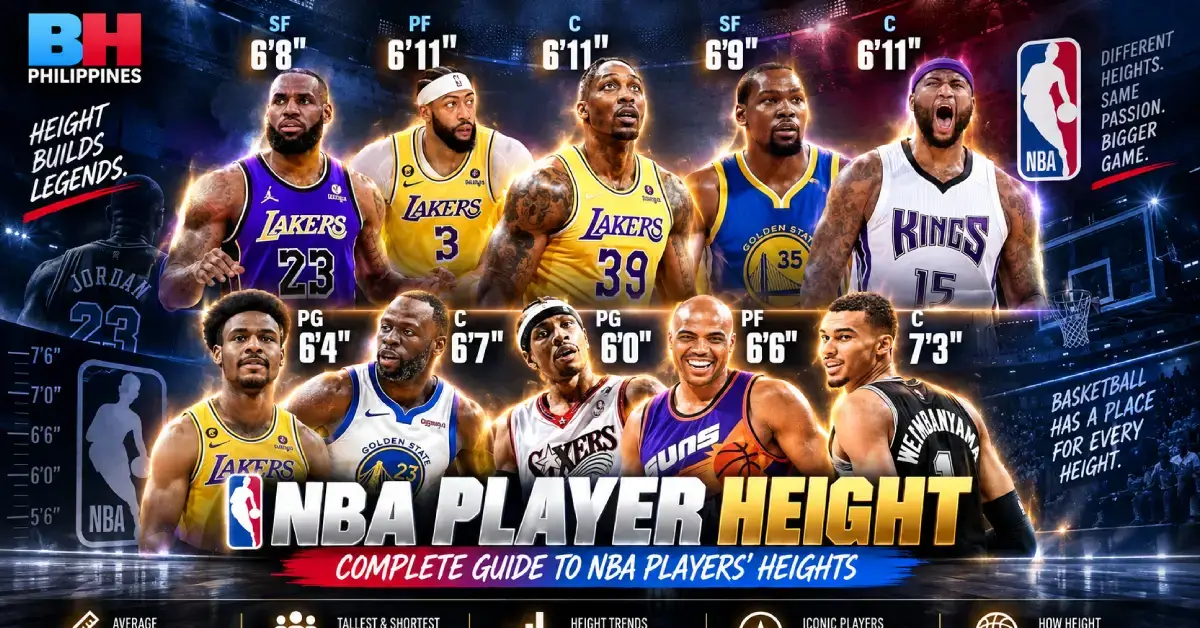
How tall are NBA players? NBA player height varies considerably by position, with current NBA rosters featuring guards around 6 feet tall, many wings between roughly 6-foot-5 and 6-foot-8, and centers commonly around 6-foot-10 to 7 feet or taller. NBA.com currently lists hundreds of players with official roster heights, including players such as Jose Alvarado at 6-foot, Devin Booker at 6-foot-5, Santi Aldama at 7 feet, and Deandre Ayton at 7 feet.
Height is one of the most noticeable physical characteristics in basketball, but it does not tell the whole story. Wingspan, standing reach, strength, mobility, ball-handling, shooting, defensive instincts, and basketball IQ all affect how a player performs.
Table of Contents
For Filipino basketball fans, understanding NBA players height can make watching games even more interesting. A listed 6-foot-7 wing may defend several positions, while a 7-foot center can change a game without scoring heavily simply through rim protection and rebounding.
What does NBA player height actually mean?
NBA player height generally refers to the height listed on the league’s official player roster.
NBA.com publishes roster information that includes each player’s position, height, weight, team, and other basic details. The current league roster, for example, lists Jose Alvarado at 6-foot, Darius Acuff Jr. at 6-foot-2, Scottie Barnes at 6-foot-8, and Santi Aldama at 7 feet.
However, basketball fans may encounter slightly different measurements for the same player.
One reason is that NBA Draft Combine testing can record height both without shoes and with shoes. The NBA’s official combine database provides both measurements alongside standing reach and wingspan.
That means a prospect might measure 6-foot-7 without shoes but 6-foot-8 with shoes.
For everyday NBA discussions, the official roster listing is usually the easiest measurement to use.
How tall are NBA players by position?
NBA positions traditionally provide a useful way to understand NBA players height.
How tall are NBA point guards?
Point guards are generally among the shorter players on an NBA roster.
Their role emphasizes ball-handling, playmaking, perimeter defense, speed, and decision-making rather than simply size.
Jose Alvarado, for example, is listed at 6-foot on the current NBA roster. Darius Acuff Jr. and Christian Anderson are listed at 6-foot-2.
That does not prevent smaller guards from becoming important NBA players.
A point guard can compensate for less height through quickness, defensive pressure, shooting range, strength, court vision, and timing.
The modern NBA has also made traditional positional labels less rigid. Guards are increasingly expected to switch defensively, rebound, and attack the basket.
How tall are NBA shooting guards?
Shooting guards are typically taller than traditional point guards, although there is considerable overlap.
Many NBA shooting guards fall around 6-foot-4 to 6-foot-6.
Devin Booker, for example, is listed at 6-foot-5 on NBA.com.
At this position, height can help with shooting over smaller defenders, finishing around the rim, rebounding from the perimeter, and defending bigger wings.
However, shooting ability and ball-handling remain more important than simply being tall.
How tall are NBA small forwards?
Small forwards generally occupy the middle of the height range.
Many are around 6-foot-6 to 6-foot-8, although modern positionless basketball creates plenty of exceptions.
Scottie Barnes is listed at 6-foot-8, while several current NBA wings and forwards are listed between 6-foot-7 and 6-foot-9.
Height becomes especially useful for wings because they often defend multiple positions.
A 6-foot-7 player with long arms may defend a point guard on one possession and a power forward on the next.
How tall are NBA power forwards?
Power forwards are generally taller and stronger than guards and wings.
A typical modern power forward may stand around 6-foot-8 to 6-foot-10.
Players such as Paolo Banchero are listed at 6-foot-10, while many other forwards fall within the same general range.
The position has changed significantly.
Traditional power forwards were expected to operate near the low post, rebound, and defend bigger players. Modern power forwards may also shoot three-pointers, initiate offense, switch onto guards, and handle the basketball.
How tall are NBA centers?
Centers are generally the tallest players on an NBA roster.
Many current centers are between 6-foot-10 and 7-foot, while some exceed 7 feet.
NBA.com’s current roster lists Steven Adams at 6-foot-11, Santi Aldama at 7 feet, and Deandre Ayton at 7 feet.
Height is especially valuable at center because these players frequently protect the rim, contest shots, box out, set screens, and finish around the basket.
Still, modern centers need more than size.
Passing, defensive positioning, mobility, shooting range, and pick-and-roll decision-making have become increasingly important.
Who are the tallest NBA players?
When discussing the tallest NBA players, it is important to distinguish between current players and all-time NBA history.
The current NBA roster includes several players listed at 7 feet or taller.
For example, NBA.com currently lists Santi Aldama, Deandre Ayton, and Mo Bamba at 7 feet. It also lists Steven Adams at 6-foot-11.
Historically, players such as Manute Bol and Gheorghe Mureșan were listed at 7-foot-7, making them among the tallest players ever associated with the NBA.
Height at that level is extremely unusual even within professional basketball.
The important point is that being extremely tall does not automatically make someone an elite basketball player. NBA success requires skills that work alongside size.
What is the NBA player height list for current players?
A useful NBA player height list can be organized into broad height groups.
Players around 6-foot to 6-foot-3 are generally guards.
Players around 6-foot-4 to 6-foot-6 include many guards and wings.
Players around 6-foot-7 to 6-foot-9 commonly play wing and forward positions.
Players around 6-foot-10 to 7 feet are frequently forwards or centers.
Players above 7 feet are among the tallest players in the league.
These are broad categories rather than strict rules.
NBA.com illustrates the variety clearly. Its current roster includes players listed at 6-foot, 6-foot-2, 6-foot-5, 6-foot-8, 6-foot-10, 6-foot-11, and 7 feet.
The modern NBA is increasingly positionless, so height should be viewed as one part of a player’s overall basketball profile.
Why does NBA height matter in basketball?
Height can create advantages in several areas of the game.
A taller player may have an easier time contesting shots, grabbing rebounds, passing over defenders, finishing at the rim, and defending post players.
Standing reach is especially important.
Two players can have similar heights but very different standing reaches because of differences in arm length and body proportions.
NBA Draft Combine testing measures standing reach and wingspan alongside height.
This helps explain why a player who appears average in height can still have a major defensive impact.
A long wingspan can make it easier to disrupt passing lanes, contest jump shots, and challenge ball-handlers.
For centers, standing reach is particularly useful when evaluating rim protection.
Is height more important than wingspan?
Not necessarily.
Height and wingspan work together.
A 6-foot-6 wing with a 7-foot wingspan can have a different defensive profile from another 6-foot-6 player with shorter arms.
NBA Combine measurements demonstrate why teams examine multiple physical measurements rather than relying on height alone. The NBA’s combine data includes height without shoes, height with shoes, standing reach, hand measurements, and wingspan.
Wingspan can help players contest shots and defend passing lanes.
Standing reach can be particularly important around the basket.
Hand size can also influence ball control and finishing.
None of these measurements guarantees success.
They are tools teams use alongside scouting, game film, athletic testing, skills evaluation, and basketball intelligence.
Why do NBA heights sometimes look different online?
Basketball fans may notice that a player’s height is reported differently by different websites.
There are several possible reasons.
One source may use an older measurement.
Another may use a combine measurement.
Another may list height with shoes.
Some historical player profiles were also based on measurements that were not standardized in the same way as modern NBA Combine data.
The NBA’s current roster is therefore a useful reference when looking for a player’s listed height. For prospects, official combine measurements can provide more detailed information because they distinguish between height with and without shoes.
This distinction is particularly useful when comparing older players with recent prospects.
How tall is the average NBA player?
The answer depends on the season, roster sample, and methodology used.
Rather than relying on one universal number, it is more useful to understand the distribution of NBA players height.
Guards bring the lower end of the height range.
Wings and forwards occupy the middle.
Centers occupy the upper end.
Because NBA rosters contain players across all positions, the league average is naturally much higher than the height of a typical guard but lower than the height of a traditional center.
It is also important to remember that the NBA is an elite professional league.
Its players are selected for extraordinary basketball ability, so comparisons with the general population do not tell us much about basketball performance.
Who is the shortest NBA player?
The NBA has historically featured players under 6 feet tall, demonstrating that elite basketball ability does not require exceptional height.
Muggsy Bogues, listed at 5-foot-3 during his NBA career, remains the most famous example.
His career demonstrated how speed, ball-handling, court vision, anticipation, and defensive pressure can compensate for a significant size disadvantage.
Among current players, NBA roster data includes guards around the 6-foot range, such as Jose Alvarado.
That is an important lesson for basketball fans.
Height can provide advantages, but basketball is a skill-based sport.
Who are some of the tallest NBA players in history?
The NBA has had several exceptionally tall players.
Manute Bol was listed at 7-foot-7 and became one of the most famous shot blockers in NBA history.
Gheorghe Mureșan was also listed at 7-foot-7 and played for the Washington Bullets and New Jersey Nets.
Yao Ming stood 7-foot-6 and became one of the most influential international players in NBA history.
These players demonstrate how extraordinary height can affect the game.
A player standing more than 7-foot-5 can alter the geometry of the court simply through reach and positioning.
But extreme height also creates different physical demands, which is why basketball teams evaluate mobility, coordination, conditioning, and injury history alongside measurements.
How has NBA player height changed over time?
NBA player height has evolved as basketball itself has changed.
Earlier generations often featured clearly defined positions.
Point guards handled the ball.
Shooting guards scored from the perimeter.
Small forwards operated between the wings and frontcourt.
Power forwards played closer to the basket.
Centers protected the rim.
Modern basketball is more flexible.
A 6-foot-8 forward may initiate an offense.
A 6-foot-5 guard may defend centers during switches.
A 7-foot center may shoot three-pointers and function as a playmaking hub.
This development means height still matters, but positional skills increasingly matter alongside it.
The modern NBA rewards players who can perform multiple basketball tasks.
Why should fans look at height and position together?
Looking at height alone can create a misleading picture.
A 6-foot-7 player could be a guard, wing, or forward depending on his skills and the team’s system.
Similarly, a 6-foot-10 player might operate as a traditional center or spend significant time playing power forward.
This is why an NBA player height list becomes more useful when combined with position.
For Filipino basketball fans, this can make NBA games easier to understand.
When a team switches defensively, for example, you can see why certain players are able to defend different positions.
A long wing may be assigned to a point guard.
A mobile center may switch onto a perimeter player.
A smaller guard may fight through screens rather than switch onto a much taller opponent.
Height is part of the tactical picture.
What should fans remember about NBA player height?
The most important lesson is simple: height helps, but it does not define a basketball player.
The NBA features guards who succeed through speed and skill, wings who use length and versatility, forwards who combine size with shooting, and centers who dominate through rim protection and rebounding.
The current NBA roster demonstrates a remarkable range, from players listed around 6 feet to multiple players listed at 7 feet.
Official combine data also shows why height should be considered alongside wingspan and standing reach.
For fans, that makes NBA player height an interesting starting point rather than the complete story.
Conclusion: Why NBA Player Height Matters
NBA player height is one of the easiest ways to understand the physical diversity of professional basketball.
The current league includes guards around 6 feet, versatile wings around 6-foot-6 to 6-foot-8, forwards around 6-foot-9 and 6-foot-10, and centers reaching 7 feet or more. NBA.com provides the current official roster heights, while NBA Draft Combine measurements offer additional details such as height without shoes, standing reach, and wingspan.
The tallest NBA players demonstrate how unusual size can affect rim protection, rebounding, and finishing, while smaller guards show that elite ball-handling, shooting, speed, and basketball IQ can be just as important.
Ultimately, the best way to understand NBA players height is to look at it alongside position, wingspan, standing reach, skill set, and role.
Join the Discussion
NBA player height can tell you a lot about how the modern game is played, but every player’s skill set makes the numbers more interesting. Which NBA player’s height surprises you the most, and which player do you think gets the most out of his size? Share your thoughts with fellow basketball fans, follow Basketball Hub PH on Facebook and Instagram, and visit our store for general basketball merchandise, including Basketball T-Shirts, Basketball Wall Art, jerseys, and more.
Frequently Asked Questions
How tall is the average NBA player?
There is no single permanent average because NBA rosters change every season. The league contains players across a wide range, with guards generally shorter than forwards and centers.
Who is the tallest NBA player?
Manute Bol and Gheorghe Mureșan are commonly recognized among the tallest NBA players ever, both listed at 7-foot-7 during their NBA careers.
Who is the shortest NBA player in NBA history?
Muggsy Bogues, listed at 5-foot-3, is widely recognized as the shortest player in NBA history.
Are NBA player heights measured with shoes?
It depends on the source and measurement. NBA Draft Combine data specifically records both height without shoes and height with shoes. Official NBA roster listings provide a player’s listed league height.
Does height determine NBA success?
No. Height can provide advantages, especially around the basket, but shooting, ball-handling, athleticism, defense, decision-making, basketball IQ, and other skills are also crucial.