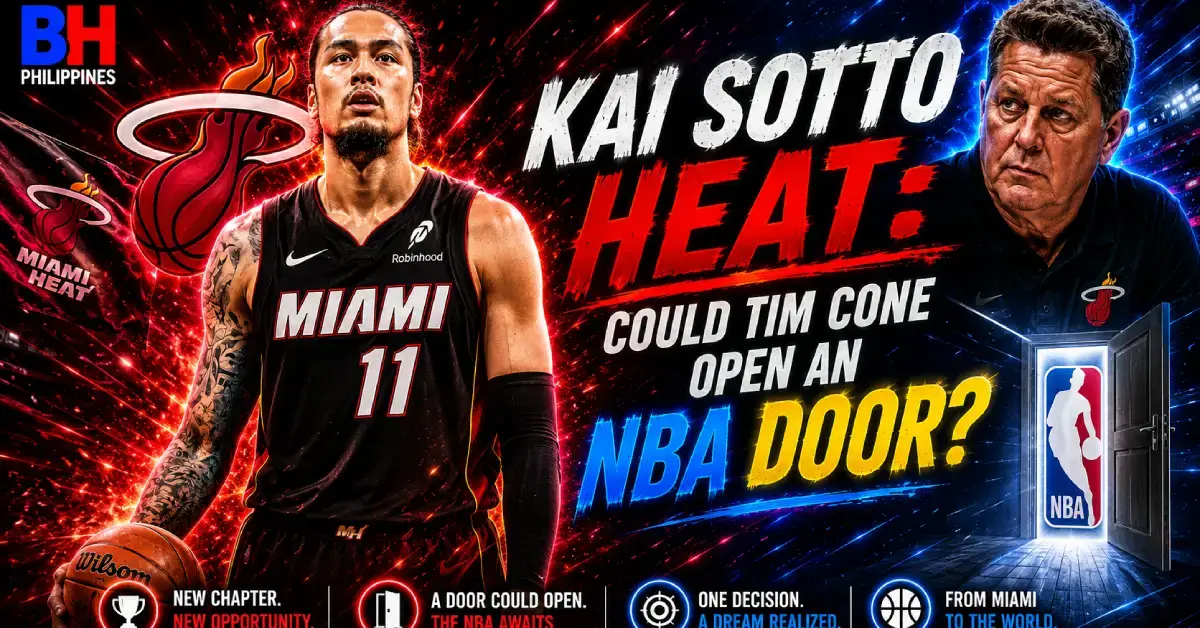

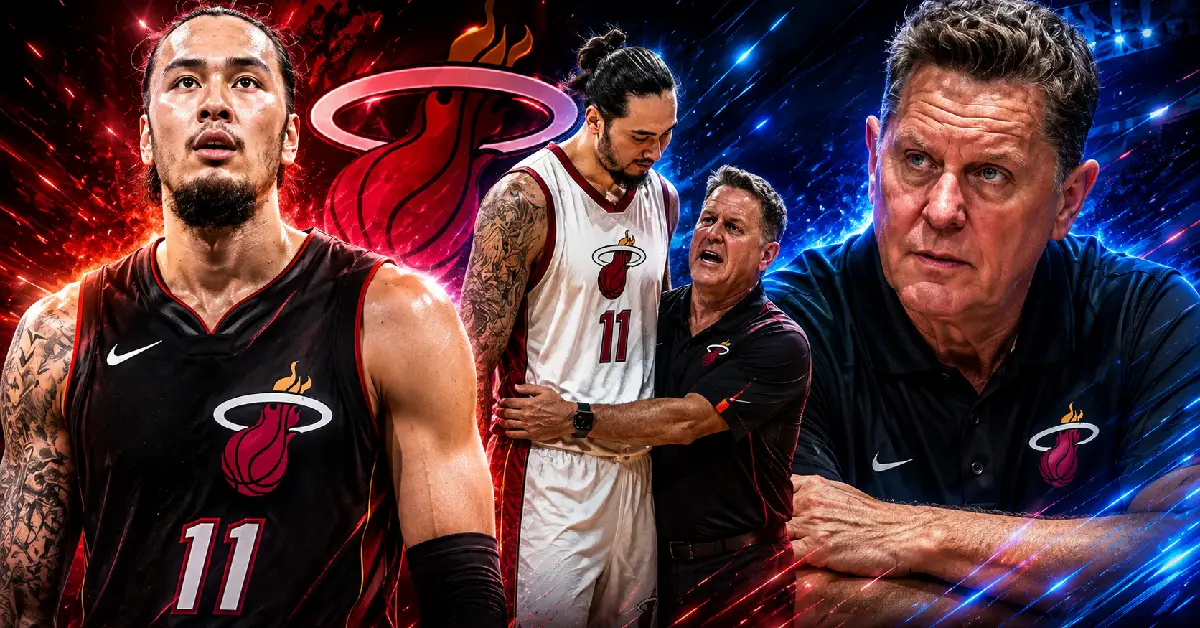
Could Kai Sotto fit the Miami Heat from an X-and-O perspective? The answer is potentially yes, but only in a very specific role.
Sotto’s 7-foot-plus size, rebounding and rim-protection potential would give Miami something different from Bam Adebayo. But fitting into the Heat system would require more than being a tall center.
The real test would be defensive positioning, pick-and-roll coverage, conditioning, screening, passing and decision-making.
Miami’s basketball identity has historically demanded versatility from its big men. Adebayo is the clearest example. He has been used as a switch defender, screener, passer, rebounder and interior defender rather than simply as a traditional rim-protecting center. Miami’s own analysis has highlighted how Adebayo’s ability to defend different positions allows Erik Spoelstra to use multiple defensive coverages.
That raises an interesting question for Filipino basketball fans:
If Kai Sotto ever received an opportunity with Miami, could he become a useful backup center behind Bam Adebayo?
What would Kai Sotto bring to the Heat?
The first thing would be size.
Sotto is commonly listed at 7-foot-3, giving him a different physical profile from Adebayo.
Bam is listed at 6-foot-9 and has built his defensive reputation around mobility, switching and positional versatility.
Sotto would offer a more traditional interior presence.
He could potentially provide:
- Size around the rim
- Defensive rebounding
- Interior screening
- Paint scoring
- Vertical finishing
- Shot contesting
- A larger target for pick-and-roll passes
That does not mean Sotto would immediately be ready for an NBA rotation.
It means his physical profile could give Miami a different tactical option.
How different are Sotto and Bam Adebayo?
This is where the hypothetical becomes interesting.
Adebayo is not a traditional center in the old-school sense.
Miami has used him in actions that require him to switch onto guards, defend in space, communicate defensive rotations and operate away from the basket. Spoelstra has described Adebayo as capable of defending within virtually any scheme.
Sotto’s potential value would be different.
Instead of trying to replicate Bam, he could provide a change of style.
Imagine a second unit that needs:
A bigger screen.
A stronger rebounding presence.
A vertical target around the rim.
A center who can occupy the paint.
Those are areas where Sotto’s size could potentially become useful.
The key is that Miami would not need him to become another Bam.
It would need him to provide something the roster does not already have.
Could Kai Sotto be a backup center behind Bam?
In theory, yes. In practice, it would be a difficult role to earn.
Miami’s current roster already includes several frontcourt players, including Bam Adebayo, Nick Richards, Vladislav Goldin and Bobby Portis.
That means Sotto would have to compete for a role rather than simply step into an empty position.
If Miami were ever interested in him, the most realistic basketball question would be:
Can Sotto give the second unit something valuable without forcing Spoelstra to completely change his defensive system?
That is the real fit test.
Would Sotto fit Miami’s defensive system?
This is probably the biggest question.
Miami’s defense has frequently relied on switchable players and the ability to change pick-and-roll coverages.
Adebayo’s mobility is central to that approach.
Miami has also shown that it can use drop coverage, zone and other defensive looks depending on personnel and matchup.
Sotto would probably be most comfortable in a more traditional drop or paint-oriented coverage.
That could actually be useful.
Instead of asking Sotto to switch onto elite guards every possession, Miami could potentially use his size to protect the paint while its perimeter defenders fight over screens.
The problem is that NBA offenses will test a slower-footed center.
Opponents can bring Sotto into pick-and-roll actions repeatedly.
If he drops too far, the ball handler gets room to shoot.
If he steps too high, the guard can attack the space behind him.
If he switches, he may be forced to defend a much smaller player.
That is the tactical problem Sotto would have to solve.
Could Sotto play drop coverage for Miami?
This could be one of his more realistic defensive pathways.
In drop coverage, the center stays closer to the basket while the guard defender attempts to slow the ball handler.
The center’s job is to protect the paint, read the roller and contest shots without giving up an easy lane to the basket.
Sotto’s length could be valuable here.
A 7-foot-plus center does not have to aggressively chase every ball handler to influence a possession.
If he maintains good positioning, his reach can make finishing difficult.
Miami has previously adjusted its defensive system depending on its personnel, including using more conservative coverages when Adebayo was unavailable.
That demonstrates an important principle:
Spoelstra does not need every player to defend exactly the same way.
The question would be whether Sotto can execute his assigned coverage consistently.
Would Sotto need to switch like Bam?
Probably not on every possession.
Trying to make Sotto play exactly like Adebayo would make little basketball sense.
Bam’s mobility is one of his defining defensive advantages.
Sotto’s advantage is his size.
The smarter hypothetical would be to build a defensive package around Sotto’s strengths.
For example, Miami could use more drop coverage when Sotto is on the floor while maintaining its aggressive perimeter defense.
That could allow Sotto to stay closer to the paint.
But there would still be situations where he has to switch.
NBA teams will hunt mismatches.
If Sotto cannot survive even a limited number of switches, opponents can target him.
That makes lateral movement and defensive footwork critical areas for his development.
Could Sotto protect the rim better than Bam?
Not necessarily.
This is an important distinction.
Being taller does not automatically make someone a better defender.
Adebayo’s defensive value comes from his combination of strength, speed, anticipation, positioning and versatility.
Miami’s own analysis has emphasized that the team uses Adebayo not simply as a rim protector but as a defender capable of handling different actions and assignments.
Sotto could offer greater vertical length.
But Bam offers exceptional mobility.
Those are different defensive tools.
The hypothetical advantage for Sotto would be having a bigger body near the basket.
The advantage for Bam is being able to move almost anywhere on the defensive end.
Where could Sotto help in the pick-and-roll?
This is where Sotto could potentially have an offensive role.
A center does not need to score 20 points to make a pick-and-roll effective.
The screen itself can create an advantage.
Sotto’s size could make him a difficult screener to navigate around.
After setting the screen, he could roll toward the basket.
His height would give the ball handler a large target.
If the defense collapses, he could potentially finish or make the extra pass.
The important skill would be timing.
A screen that arrives too early or too late does not create the same advantage.
Sotto would need to learn the exact timing expected by Miami’s guards.
Could Sotto become a lob threat?
Potentially.
A 7-foot-plus center naturally gives guards a large target above the rim.
That could make the pick-and-roll particularly interesting.
If a guard gets around the first defender, Sotto could dive toward the basket.
The defense would then have to decide whether to protect the rim or stay attached to shooters.
That creates the basic pick-and-roll dilemma.
Sotto’s role would not have to involve complicated post moves.
He could create value through:
Screen → roll → catch → finish.
For a backup center, simplicity can be an advantage.
Could Sotto space the floor?
This is one of the biggest questions.
Modern NBA offenses value centers who can shoot because spacing makes driving lanes easier to create.
If Sotto becomes a reliable outside shooter, his offensive possibilities become much broader.
A defender cannot simply sit in the paint.
However, Sotto does not need to become a high-volume three-point shooter immediately.
He would first need to demonstrate that defenses cannot completely ignore him away from the basket.
Even respectable shooting could change how teams defend the pick-and-roll.
That would make his offensive skill development important.
What about Sotto’s passing?
Passing could be another pathway to fitting into an NBA offense.
A big man who can catch the ball at the elbow or post and quickly find an open teammate gives the offense another decision-maker.
Sotto has shown passing flashes throughout his development.
The challenge is doing it at NBA speed.
NBA defenses close space extremely quickly.
A passing window that appears open for a moment can disappear immediately.
Sotto would need to make quick reads rather than holding the ball.
That means:
Catch → read → pass.
Not:
Catch → hold → wait → react.
That difference can determine whether a big man’s passing becomes an advantage or a source of turnovers.
Would Sotto fit the Heat’s offensive philosophy?
Potentially, especially as a complementary center.
Miami does not need every player to be a primary scorer.
A backup big can contribute through screens, offensive rebounds, handoffs, rolls and interior finishing.
Sotto could potentially fill that type of role if his efficiency is high enough.
The challenge would be spacing.
If he cannot shoot and the opposing center can stay near the paint, Miami’s offense could become easier to defend.
That means Sotto’s offensive value would depend on what happens after the screen.
If he rolls hard, he creates pressure.
If he can pass, he punishes help defense.
If he can shoot, he creates spacing.
The more options he provides, the more valuable he becomes.
What does “Heat Culture” actually mean for Sotto?
“Heat Culture” is often reduced to a slogan about toughness.
From a basketball perspective, it is more useful to think of it as a demand for preparation, conditioning, accountability, defensive discipline and role acceptance.
That matters for Sotto.
A player cannot simply rely on being 7-foot-3.
Miami would expect him to be physically prepared, understand the defensive game plan and execute his role.
For a center, that means sprinting into screens, running back in transition, communicating on defense, boxing out and making the correct coverage call.
Those details are what separate physical talent from reliable NBA production.
Could Sotto handle Miami’s defensive communication?
That would be another major test.
The center often functions as the quarterback of a defense.
He sees the action developing in front of him.
He has to communicate screens.
He has to identify cutters.
He has to call out coverage.
He has to know where the low man is coming from.
Miami’s defensive system places significant responsibility on its bigs, particularly because Adebayo has been able to organize and adapt within different coverages.
Sotto would therefore need strong defensive communication.
His physical tools would not be enough by themselves.
Could Sotto learn Miami’s system?
There is no reason to assume he could not learn it.
The more important question is how quickly.
NBA systems are complicated.
Players have to understand terminology, rotations, scouting adjustments and opponent-specific game plans.
For a center, a single missed rotation can create an open three or a direct path to the rim.
Sotto’s basketball IQ would therefore become extremely important.
If he can process the game quickly, his size becomes more valuable.
If he struggles to react, his physical advantages become harder to use.
What would Sotto’s ideal Heat role look like?
If we are talking strictly about basketball fit, the most realistic hypothetical role would be a situational backup center.
His minutes could be used when Miami needs:
- More size
- More defensive rebounding
- A stronger interior target
- A vertical pick-and-roll threat
- A different look from its smaller lineups
He would not need to replace Bam.
He would complement him.
That is an important distinction.
How could Sotto and Bam be different stylistically?
Bam gives Miami defensive versatility.
Sotto could give Miami interior size.
Bam can switch.
Sotto would likely prefer more conservative coverage.
Bam can operate comfortably away from the basket.
Sotto’s natural value is closer to the rim.
Bam can defend guards.
Sotto’s development would need to focus on becoming reliable enough against movement-based actions.
Those differences could actually make the pairing conceptually interesting.
A team does not necessarily need identical centers.
Different defensive tools can give a coach more matchup options.
Could Sotto play alongside Bam?
This would be more complicated.
Playing two centers together can reduce offensive spacing.
If neither player is a consistent perimeter threat, opponents can pack the paint.
There could be situations where the size advantage is useful, particularly against large frontcourts.
But against a team that plays five-out basketball, the pairing could become difficult.
That is why Sotto would probably make more sense as a backup option rather than someone expected to share the floor with Bam for long stretches.
What would Sotto need to improve before an NBA rotation?
The priority list is fairly clear.
1. Defensive footwork
He needs to move efficiently enough to defend pick-and-roll actions without constantly being targeted.
2. Conditioning
The NBA pace demands repeated high-intensity actions.
3. Strength
He needs to hold position against powerful NBA centers.
4. Defensive communication
He must know the coverage before the action develops.
5. Shooting
Even modest shooting improvement could create more offensive flexibility.
6. Passing speed
Quick decisions are essential against NBA rotations.
7. Screen quality
A center can create significant value by becoming an excellent screener.
What did the Orlando Summer League experience tell us?
Sotto’s 2023 Orlando Magic Summer League experience provides useful context.
In his debut against Portland, the 7-foot-3 center recorded six points, four rebounds, three blocks and one assist in 14 minutes.
The three blocks demonstrated his natural rim-protection potential.
But the limited minutes and small sample also show why it would be premature to declare that he was already NBA-ready.
Summer League exposed him to the pace and physical demands of NBA-level competition.
For a hypothetical Heat role, the lesson is straightforward:
His physical tools can translate. His consistency and defensive mobility would have to catch up.
Could Miami’s development system help Sotto?
Potentially.
Miami has a long reputation for demanding detailed preparation from its players.
But development is not magic.
A coaching staff can provide structure, film study, strength work and tactical instruction.
The player still has to execute.
For Sotto, the most valuable development would probably involve translating his physical gifts into repeatable NBA actions.
Instead of asking, “Can Kai block shots?”
The better question is:
Can Kai consistently be in the right place to contest shots?
Instead of asking, “Can Kai score inside?”
Ask:
Can Kai set the screen, make the correct read and finish efficiently?
Those are NBA questions.
What is the biggest obstacle to a Heat fit?
The biggest obstacle is not his height.
It is whether he can defend modern NBA actions without forcing the rest of the defense to compensate for him.
If opponents can repeatedly target him in pick-and-rolls, his size becomes less valuable.
If he can hold his coverage, communicate and protect the paint, his size becomes an advantage.
That is the dividing line.
Would Sotto be a natural Heat player?
Potentially, but he would need development first.
His willingness to do the less glamorous work would matter.
Set screens.
Box out.
Run the floor.
Defend the correct coverage.
Make the extra pass.
Take the open shot.
Repeat those actions consistently.
That type of role can fit almost any NBA system.
The challenge is doing it at NBA speed.
So, could Kai Sotto be Bam Adebayo’s backup?
As a basketball concept, yes. As a current roster projection, it is much less certain.
Miami already has multiple bigs on its roster, including Bam Adebayo, Nick Richards, Vladislav Goldin and Bobby Portis.
Sotto would therefore need to earn the role.
If he were ever considered for it, the attraction would be his ability to provide a different interior profile.
Bam gives Miami switchability and defensive versatility.
Sotto could potentially provide greater size and a more traditional paint presence.
That contrast could be useful in specific matchups.
But the key would be whether Sotto can defend well enough to stay on the floor.
What is the final X-and-O verdict?
The hypothetical Kai Sotto Miami Heat fit is intriguing because the two sides could complement each other.
Miami would not need Sotto to become Bam Adebayo.
It would need him to become a reliable version of himself.
A big center who screens well, rebounds, protects the paint, finishes efficiently and understands defensive rotations could have a role.
But there is a major development gap between those requirements and being ready for consistent NBA minutes.
The biggest question is defense.
If Sotto can improve his mobility, footwork and pick-and-roll coverage, his size becomes much more useful.
If he can also develop his shooting and passing decisions, his offensive fit becomes stronger.
That is where the hypothetical becomes realistic.
The Heat Culture test would not be whether Sotto is tough enough. It would be whether he can execute his role, possession after possession, at NBA speed.
Conclusion: Could Kai Sotto Fit the Miami Heat?
The hypothetical Kai Sotto Miami Heat fit is more interesting from an X-and-O perspective than simply asking whether he is tall enough to play center.
Sotto’s size could give Miami a different option around the basket, while Bam Adebayo’s versatility allows the Heat to play a much more switch-heavy and mobile style with him on the floor.
The challenge for Sotto would be defensive execution.
He would need to improve his lateral movement, pick-and-roll coverage, communication, conditioning and physicality. Offensively, becoming a dependable screener, roller, passer and eventually a credible floor spacer would make him easier to fit into an NBA rotation.
So could he be a backup center behind Bam?
Theoretically, yes. But the path would depend on whether Sotto can turn his physical advantages into reliable NBA possessions.
That is the real Heat Culture test.
Join the Discussion
Basketball brings Filipino fans together, and Kai Sotto Miami Heat raises an interesting basketball question: could his size and interior game complement Bam Adebayo and fit Erik Spoelstra’s defensive system? Follow BasketballHubPH on Facebook to join the conversation, follow the latest Philippine basketball stories, and stay updated on NBA discussions involving Filipino players.
You can also explore our BasketballHubPH online store for basketball T-shirts, jerseys, wall art, and other basketball merchandise.
Let’s keep the conversation alive about Kai Sotto Miami Heat, Heat Culture, Bam Adebayo, NBA defensive schemes, and the X-and-O side of basketball. Join us today, follow us on social media, visit our store, and show your support for Philippine basketball!
Frequently Asked Questions
Could Kai Sotto fit the Miami Heat?
Potentially. His size, rebounding and interior presence could give Miami a different type of center. However, he would need to improve his defensive mobility, conditioning and pick-and-roll coverage to become a reliable NBA rotation player.
Could Kai Sotto be Bam Adebayo’s backup?
In theory, Sotto could provide a different style of center behind Adebayo. Bam’s versatility allows Miami to switch and defend in space, while Sotto could potentially provide more traditional size and interior presence. Miami already has several frontcourt players, however, so a roster spot would have to be earned.
Would Kai Sotto need to switch on defense in Miami?
Not necessarily on every possession. Miami has used different pick-and-roll coverages, including switching and drop coverage. Sotto’s potential fit would likely depend on whether he can execute a more conservative coverage while still handling situations where he is forced to move into space.
What would Kai Sotto need to improve for an NBA role?
His biggest priorities would be defensive footwork, lateral mobility, conditioning, strength, defensive communication, pick-and-roll reads and offensive versatility.
What did Kai Sotto show in the Orlando Magic Summer League?
In his 2023 Summer League debut for Orlando, Sotto recorded six points, four rebounds, three blocks and one assist in 14 minutes against Portland. The performance highlighted his rim-protection potential while giving him experience with NBA-level pace.